Semen Sample Rules: How Many Days Should You Abstain—and Why Can Too Long Be Worse?
For semen analysis, WHO uses 2–7 days without ejaculation, while many labs require 2–5 or 3–5. Learn why longer can raise count but worsen other measures, and how collection and transport affect the result.

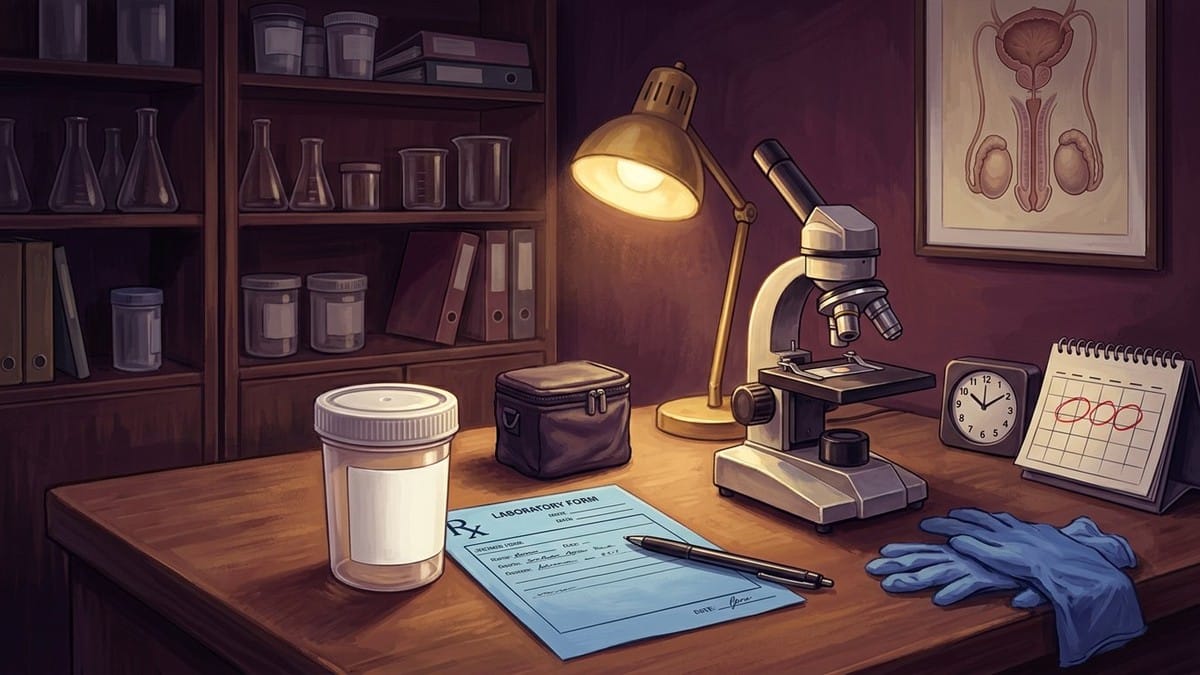
Asked at 2am. Answered from sources. For a routine diagnostic semen analysis, the World Health Organization laboratory standard is 2–7 days without ejaculation. Many fertility laboratories narrow that to 2–5 or 3–5 days. Your laboratory's written window is the one that counts — collecting on day 8 because you want a bigger count can lead to rejection or a sample that is harder to interpret.
The short version
- Diagnostic semen analysis: WHO allows 2–7 days; UCLH and Leeds Teaching Hospitals both use a tighter 3–5-day target in their patient instructions.
- IUI/IVF treatment sample: SART describes 2–5 days as common, but a clinic may specifically request less than 2 days.
- Too long is not automatically better: more abstinence tends to increase semen volume and sperm numbers, while the percentage of progressively motile sperm can fall and sperm DNA fragmentation can rise.
- Abstinence means no ejaculation — by masturbation, intercourse, partner stimulation or a nocturnal emission.
- Collection quality matters as much as the day count: collect the whole sample, especially the first portion, in the lab-supplied pot; avoid ordinary lubricants and ordinary condoms; keep a home sample at body temperature and deliver it by the laboratory deadline.
Why different clinics give different day counts
The WHO Laboratory Manual for the Examination and Processing of Human Semen is designed to make results comparable between laboratories. Its 2–7-day window is a standard collection condition, not a promise that every parameter peaks at day 7.
Individual laboratories narrow the window to reduce variation and failed appointments. UCLH says 3–5 days gives its best results and that samples after less than 2 or more than 7 days cannot be accepted because the result can be compromised. Leeds Teaching Hospitals also requires 3–5 days and may ask a patient with the wrong interval to rebook.
A treatment sample has a different purpose again: the clinic is collecting sperm to use, not just measuring it against a reference population. The Society for Assisted Reproductive Technology says IUI and IVF protocols vary, commonly use 2–5 days, and sometimes request a shorter interval.
| Why are you producing the sample? | Published interval pattern | What controls your appointment? |
|---|---|---|
| Diagnostic semen analysis | WHO 2–7 days; many labs use 2–5 or 3–5 | The analysing laboratory's instruction sheet |
| IUI or IVF/ICSI treatment | Commonly 2–5 days; shorter may be requested | The fertility clinic and embryology/andrology lab |
| Sperm DNA-fragmentation test | Assay-specific; short intervals are sometimes deliberately used | The testing laboratory — ask before scheduling the last ejaculation |
| Sperm freezing | Clinic protocol; more than one sample may be required | The cryobank/fertility clinic |
| Post-vasectomy analysis | A pre-sample abstinence interval may still be specified | Both the lab interval and the operating service's post-vasectomy clearance protocol |
| Mail-in home test | Kit-specific abstinence and transport system | The validated kit instructions, not a hospital hand-delivery deadline |
How to count the days
Count from the last ejaculation, not from the last time you were aroused. Leeds expresses its 3–5-day rule plainly: you should have ejaculated 3–5 days before the appointment, and not since.
If the appointment is Friday at 10am and the target is 3–5 days, the last ejaculation would normally fall between about Monday 10am and Wednesday 10am, depending on whether the target is closer to 4 or 2 full days. If the laboratory states “at least 48 hours,” use clock time, not calendar labels. Aim for the middle of the permitted window so a small appointment move does not push you outside it.
These events reset the clock:
- masturbation with ejaculation;
- vaginal, anal or oral sex with ejaculation;
- hand or other partner stimulation with ejaculation;
- a wet dream/nocturnal emission.
An erection itself does not reset an ejaculatory abstinence clock. But some laboratory forms use the broader phrase “sexual abstinence.” If sexual activity occurred without ejaculation, do not hide it — record it or ask the lab whether the appointment should move.
What too few or too many days does to the result
Abstinence duration pulls semen parameters in different directions. A 2025 systematic review and meta-analysis of 22 studies and 31,640 samples found that intervals under 2 days were associated with lower semen volume and sperm concentration, but also lower sperm DNA fragmentation and higher percentages of total and progressively motile sperm. Overall morphology did not differ.
| Parameter | Shorter abstinence tends to show | Longer abstinence tends to show |
|---|---|---|
| Semen volume | Lower | Higher |
| Sperm concentration / total stored numbers | Lower | Higher |
| Total and progressive motility percentages | Higher | Lower |
| Sperm DNA fragmentation | Lower | Higher |
| Normal morphology percentage | No consistent overall advantage | No consistent overall advantage |
WHO explains part of the mechanism: sperm accumulate in the epididymides, but the epididymides are not completely emptied by one ejaculation. A longer interval therefore changes both the stored quantity and the age mix of sperm being examined.
That does not make a same-day or next-day sample universally better. A higher motility percentage in a much smaller ejaculate may not answer a diagnostic question in the same way, and a treatment team may care about the total usable motile sperm recovered after preparation. The evidence argues against “save up for as long as possible,” not for ignoring the laboratory and choosing your own ultra-short interval.
Do not confuse a lab sample with trying to conceive
Advice for natural conception answers a different question: how often to have intercourse during the fertile window. The American Society for Reproductive Medicine says frequent ejaculation is a common misconception as a cause of reduced male fertility; in one analysis of almost 10,000 specimens, men with normal semen quality maintained normal concentration and motility even with daily ejaculation. ASRM also notes deterioration after abstinence intervals of 10 days or more.
That is useful reassurance for couples trying naturally. It is not permission to arrive for a diagnostic test outside the laboratory's standard collection window. Our IVF stage-by-stage guide treats treatment-cycle timing separately for the same reason.
Collection rules that can matter as much as the day count
1. Collect the whole ejaculate — especially the beginning
WHO emphasizes that the first fractions are mainly sperm-rich prostatic fluid. Losing the first portion can affect concentration and total sperm number more than losing the last portion. If any part misses the pot, tell the laboratory. A declared partial sample is better than a falsely “complete” one.
2. Use only the container supplied
The laboratory pot is selected/verified as non-toxic to sperm. A household jar, drinks bottle, ordinary condom or transfer from another container can contaminate the sample or expose sperm to spermicidal/toxic residues. Label it exactly as instructed and record the production time.
3. Clean and dry, but leave no residues
SART and hospital instructions tell patients to wash and dry their hands and, where directed, cleanse the penis and rinse/dry away soap or water. Do not use ordinary lubricant, saliva, soap, oil or hand cream to help collection unless the laboratory has supplied a validated non-spermatotoxic product.
4. Masturbation is the default method
Withdrawal during intercourse risks losing the first fraction and contaminating the specimen. An ordinary contraceptive condom must not be used. If masturbation is not possible for medical, personal or religious reasons, ask in advance: some services can provide a special non-toxic collection condom or arrange another clinical method.
5. Keep a home sample warm and move quickly
WHO's transport range is 20–37 °C (68–98.6 °F). Keep the sealed pot close to the body, such as in an inside pocket/under clothing, and protect it from direct heat or cold. WHO aims for examination within 60 minutes; UCLH asks for delivery within an hour and accepts up to 90 minutes. Your lab's deadline wins. Do not refrigerate, freeze or place it on a heater.
What if the interval went wrong?
Call before you travel or produce the sample. If you ejaculated yesterday when the lab requires a minimum of 2 days, or the last ejaculation was 9 days ago when the maximum is 7, the service may simply rebook. If the sample has already been produced, record the exact abstinence interval rather than rounding it into the accepted range; the clinician may still learn something, repeat the test, or reject it under local policy.
Tell the laboratory about:
- a nocturnal emission during the abstinence window;
- spillage, especially loss of the first portion;
- lubricant, saliva, an ordinary condom or an unapproved container;
- recent fever or significant illness;
- prescribed medicines, testosterone/anabolic steroids and supplements;
- a transport delay or exposure to unusual heat/cold.
Do not stop prescribed medication to improve a sample unless the prescribing clinician tells you to.
How to read the result without over-reading it
The abstinence interval should appear in the report or clinical interpretation. A result after 1 day and a result after 7 days are not a clean before-and-after comparison. For a repeat, try to use the same target interval, collection location and transport timing unless the clinician is deliberately testing a different protocol.
UCLH warns that samples from the same person can vary greatly and that repeat tests may be requested. WHO likewise says defining an exact individual baseline may require two or three ejaculates. A single value below a reference distribution is not, by itself, proof that pregnancy is impossible; it is a reason for a clinician to interpret the whole picture and decide whether to repeat or investigate.
Post-vasectomy testing needs a separate caution: the days since last ejaculation do not replace the operating service's rules about time since surgery, sample schedule and what result counts as clearance. See Sex and Masturbation After a Vasectomy: The Two Different Clocks.
Questions asked at 2am
Is day 7 better than day 3?
It may produce more volume and more total sperm, but it may also show lower motility percentages and higher DNA fragmentation. “Better” depends on the clinical purpose. For a diagnostic test, being inside the laboratory's standard window matters more than chasing one larger number.
I had a wet dream the night before. Is the appointment wasted?
A nocturnal emission is an ejaculation, so it resets the interval. Call the lab before attending; it may rebook or record the shorter interval depending on the test and policy.
Can I use a fertility-friendly lubricant from a shop?
Only if the analysing laboratory approves that exact product. WHO permits a validated non-spermatotoxic lubricant when absolutely necessary; a retail “fertility-friendly” claim is not the same as the lab's validated collection protocol.
I missed the first spurt. Should I add water or produce again immediately?
No. Do not add anything or try to top up the pot. Tell reception exactly what was lost. Because the first fraction is sperm-rich, the lab may request a repeat after a new abstinence interval.
Can I collect at home if I live 25 minutes away?
Possibly, if the laboratory offers home production and supplies the correct pot/form. Some services require on-site production. Confirm the maximum transport time before the appointment, not after collection.
Sources
Sources checked 21 October 2026.
- World Health Organization — Laboratory Manual for the Examination and Processing of Human Semen, 6th edition.
- University College London Hospitals — Semen analysis information.
- Leeds Teaching Hospitals — Semen Analysis.
- Society for Assisted Reproductive Technology — Collection of Semen.
- Impact of Shorter Abstinence Periods on Semen Parameters: A Systematic Review and Meta-Analysis.
- American Society for Reproductive Medicine — Optimizing Natural Fertility.
Research note: WHO's 2–7-day window standardizes diagnostic collection. It should not be read as proof that day 7 maximizes fertility or that a shorter treatment-sample instruction is a laboratory error.
Medical note: Education only, not interpretation of an individual semen result. Follow the laboratory that will analyse or use your sample; it may reject specimens collected outside its conditions.