Sex-Toy Materials and Cleaning: What “Wash Before and After” Actually Requires
“Wash before and after” depends on material, construction and sharing. Compare cleaning, disinfection and sterilisation—and learn when boiling, dishwashers, porous materials and waterproof claims change the rule.

Asked at 2am. Answered from sources. “Wash before and after use” sounds like one instruction. It is really four decisions compressed into five words: what is the toy made of, how is it built, how much microbial reduction are you trying to achieve, and is it about to move to another person or another body opening?
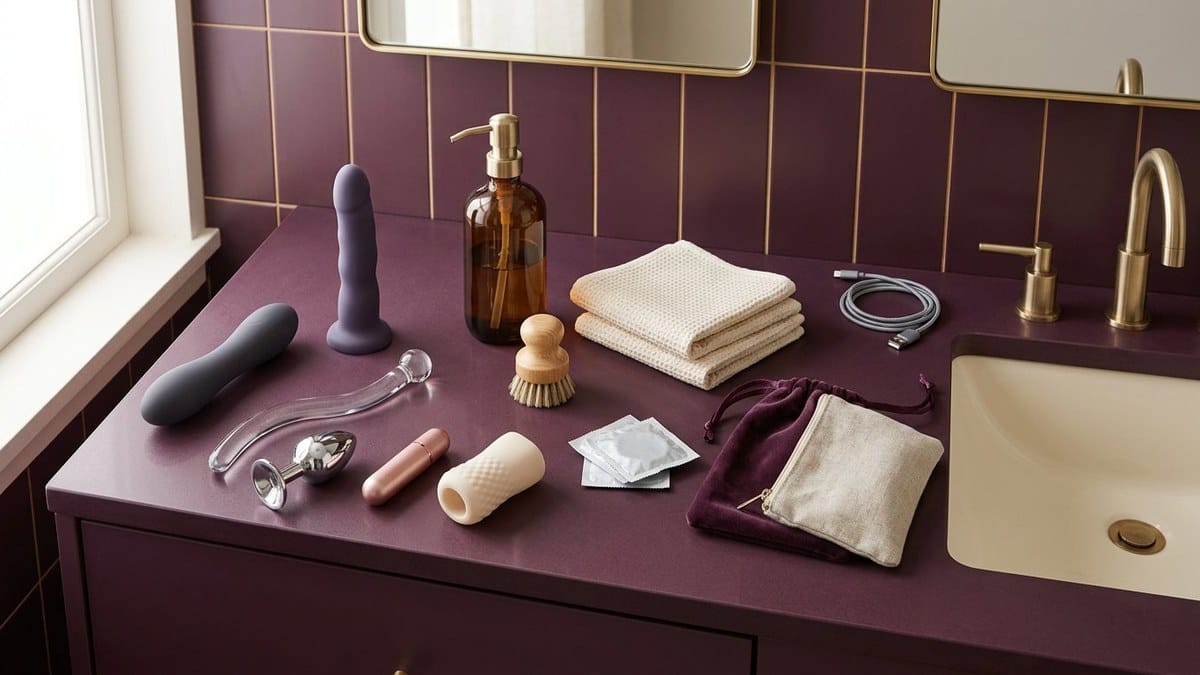
Warm water and soap are the starting point for most reusable toys. They are not a universal finishing line. A solid silicone plug, a sealed vibrator, a porous sleeve and a glass wand cannot all be boiled, soaked or shared under the same rule—even if every box uses the word “clean.”
The short version
- Wash before first use, after every use, and again before use if it collected dust in storage.
- Routine cleaning means friction: warm water where safe, mild unscented soap, hands or a soft cloth/brush in grooves, a thorough rinse and complete drying.
- Cleaning is not sterilisation. Soap removes soil and many germs. Home boiling or a dishwasher sanitize cycle can disinfect an eligible solid toy, but neither is a validated medical sterilisation process.
- Porous toys have a ceiling. TPE/TPR, PVC, vinyl, jelly, blends and other rubbery plastics can be surface-washed but cannot be made reliably sterile throughout.
- Waterproof does not mean boilable. Motors, batteries, charging contacts, coatings and seams override the surface material.
- Use a fresh condom whenever a toy changes person or body opening—especially if it is porous, electronic or cannot be heat-disinfected. Still wash the whole toy afterward.
First, use the right word for the job
| Term | What it means | What it does not promise |
|---|---|---|
| Cleaning | Soap, water and scrubbing physically remove most dirt, fluids and germs from a surface. | It does not kill everything left behind. |
| Sanitising | Reduces germs to a level a public-health standard considers safer. | It is not identical to disinfection, and product claims depend on using the stated method and contact time. |
| Disinfecting | Kills most germs remaining on a surface after cleaning, by heat or an appropriate chemical process. | It does not necessarily kill bacterial spores or reach inside porous material. |
| Sterilising | A validated process intended to destroy or eliminate all forms of microbial life, including spores. | A kitchen pot or dishwasher does not automatically meet that standard. |
These distinctions follow CDC definitions for cleaning, sanitising and disinfecting and for healthcare sterilisation. They matter because a toy can look spotless while the achievable level of germ reduction is limited by pores, seams, electronics or surface damage.
Start with two labels: material and construction
The material tells you whether fluids mostly stay on the surface. The construction tells you how much water, heat and handling the object can tolerate. A silicone surface on a sealed vibrator is still silicone, but the motor and battery make it a different cleaning problem from a solid silicone dildo.
If the packaging says only “body-safe,” “premium material” or “silicone-feel,” treat the toy as unknown and conservatively porous until the seller identifies the exact composition. “Body-safe” is not a complete chemical specification. In an exploratory 2023 laboratory study of four product types, abrasion generated micro/nanoplastic particles and chemical extraction found phthalates; the authors cautioned that the tiny sample did not represent all toys. The practical lesson is not panic—it is to buy material transparency and retire degrading surfaces.
| Material / build | Routine care | Heat or deeper disinfection? | Sharing rule |
|---|---|---|---|
| Solid 100% silicone, no motor, paint or glued parts | Warm water, mild soap and friction; soft brush for texture; rinse and dry. | Boil or dishwasher only when the maker allows that exact product. | Clean between people; fresh condom remains the simplest barrier. |
| Silicone-coated or silicone electronic toy | Wash or wipe according to its water rating and manual; keep charging contacts dry before charging. | No boiling or dishwasher because of electronics, even if immersion-rated. | Fresh condom for each person/site; wash handles and uncovered areas too. |
| Borosilicate glass, stainless steel, aluminium | Warm water and mild soap; inspect for chips, cracks, corrosion or loose parts. | Heat only for solid, manufacturer-approved glass/steel. Avoid sudden temperature shock to glass. | Non-porous and easier to clean, but still wash and use a fresh barrier between people/sites. |
| Hard ABS or rigid plastic | Warm water and mild soap if water-safe; otherwise a damp soapy cloth followed by a damp rinse cloth. | Do not boil by default; heat can warp plastic and many ABS toys contain electronics. | Fresh condom when sharing or changing site. |
| “Silicone blend,” TPE, TPR, elastomer | Gentle surface wash, thorough rinse and complete drying between folds/channels. | No reliable through-material disinfection. Do not boil unless the maker explicitly designed it for that process. | Best kept to one person. If used with partners, cover with a fresh condom each time. |
| PVC, vinyl, jelly rubber and other soft unknown plastics | Surface wash only; inspect for tackiness, odour, clouding and tears. | No. Treat as porous and formulation-unknown. | Do not rely on washing for sharing; use a fresh condom or replace with a non-porous toy. |
| Latex/rubber, leather, wood, unglazed stone and other porous materials | Follow the maker if the item was designed for body use; many cannot be thoroughly cleaned after fluid contact. | No reliable sterilisation. | Keep insertable porous items single-user. Never share anything that may draw blood. |
Planned Parenthood puts 100% silicone, hard plastic, stainless steel, aluminium and break-resistant glass in the preferred non-porous group. It warns that silicone blends, jelly rubber, PVC, vinyl, TPR, TPE, elastomer and other rubbery plastics may absorb germs even when washed. That list—not softness, price or a realistic feel—is the useful purchasing signal.
The routine wash, step by step
- Stop and make it electrically safe. Turn the toy off. Unplug it; never wash it while charging. Remove batteries only if the compartment is designed to open and the manual tells you to do so.
- Remove and bin any condom. Do not rinse and reuse it. Separate removable sleeves, caps, rings or bullet vibrators exactly as the manual allows.
- Inspect before scrubbing. Look for cracks, chips, seam splits, peeling coating and debris trapped around buttons, bases and charging points. Damage changes the cleaning plan—and may mean retirement.
- Remove surface fluid and lubricant. If the toy is water-safe, rinse under warm running water. If it is only splash-resistant, wipe with a damp cloth rather than holding seams or openings under the tap.
- Wash with friction. Use warm water and a small amount of mild, unscented liquid soap. Work over every body-contact surface with clean hands, a soft cloth or a dedicated very soft brush for grooves and texture. Wash removable parts separately. For a sleeve designed to turn inside out, clean the channel; do not force a non-removable chamber open.
- Rinse until no soap film remains. Soap residue can irritate genital or rectal tissue at the next use. For a wipe-only electronic toy, use a second barely damp cloth as the rinse step, keeping ports and seams as dry as the manual requires.
- Add disinfection only after cleaning—and only if eligible. Heat and chemicals work on surfaces, not through visible soil. Follow the toy and product labels rather than improvising a stronger mixture.
- Dry completely. Pat with a clean lint-free cloth, then air-dry on a clean surface. Channels, folds, suction nozzles, seams and charging areas need to be dry before storage or charging.
- Store dry and wash again if needed. A toy cleaned after its last use may only need a quick warm soapy wash or rinse before the next use if it was stored clean; silicone readily collects dust and lint.
A commercial toy cleaner is an alternative surface product, not a spell. If its label specifies a wet contact time, rinsing step or material restriction, those instructions are part of whether it can do the claimed job. A one-second spray wiped straight off may be little more than surface cleaning. “Antibacterial” soap is likewise not a substitute for friction, rinsing and drying.
When ordinary washing is enough—and when it is not
For a non-porous toy used by one person, on intact skin/mucosa and in the same body site, a thorough soap-and-water wash after use is the normal routine. Wirecutter's expert cleaning guide makes the same distinction: solo or fluid-bonded use generally aims for a clean toy, while shared use calls for a higher level of disinfection or a barrier.
Raise the standard when:
- another person will use the toy;
- it will move between anus, vagina and mouth;
- there are sores, broken skin, bleeding or a current genital/rectal infection;
- the surface is porous, textured, damaged or has internal channels;
- you do not know the exact material or cannot use a manufacturer-approved disinfection method.
CDC notes that shared penetrative items can transfer infected cervicovaginal or anal secretions and that HPV can persist on fomites, including sex toys. In a small 2014 study, nine women had vaginal HPV. A thermoplastic-elastomer vibrator shaft was HPV-DNA positive in 89% before cleaning, 56% immediately after a commercial cleaner and 40% of the immediately positive subset a day later. The silicone shaft results were 67%, 44% and 0%. Detecting DNA does not prove the virus remained infectious, but the study is a concrete reason not to treat one quick spray as a guarantee before sharing.
NHS guidance says shared toys should be washed between each use and covered with a new condom each time. Do not share a toy that may draw blood. If blood is present or someone has symptoms, postponing shared use and getting sexual-health advice is safer than escalating to harsher household chemicals.
Boiling, dishwashers and chemicals: where the limits are
Boiling
Boiling is only for a solid, non-electronic toy that the manufacturer identifies as heat-safe—typically verified 100% silicone, stainless steel or borosilicate glass. Clean it first. Fully submerge it in enough water, use the maker's time, watch the pot and remove it with tongs. Tantus specifies two minutes for its own silicone; Wirecutter's general expert method uses about three minutes. Cushion glass so it does not knock against the pan, let it cool naturally and dry it on a clean towel.
Do not boil a vibrator just because it is waterproof. Do not boil porous plastic, hard ABS, painted/decorated items, glued assemblies or anything with a battery, cable, motor or charging port. Boiling also cannot disinfect the inside of a porous material; it may simply damage the toy while creating false confidence.
Dishwasher
A dishwasher is an option only when the toy manual explicitly says so. The usual expert pattern is a solid eligible toy on the top rack, using a sanitize/high-heat cycle without detergent after surface cleaning. Machines reach different temperatures, detergents can leave residue, and mixed materials age differently. “Silicone” alone is not a dishwasher instruction—especially when the toy contains electronics or a separate plastic core.
Bleach, alcohol and other chemicals
This guide deliberately does not give a universal bleach recipe. Published home instructions conflict on dilution and contact time, and the wrong chemical can craze plastic, corrode metal, damage coatings or leave residue that irritates mucosa. Use a chemical disinfectant only when both the toy manufacturer and the disinfectant label authorise that material and method. Follow the exact dilution and wet contact time, ventilate, never mix chemicals, rinse thoroughly and dry completely.
Alcohol wipes, peroxide, vinegar, essential oils and UV boxes are not interchangeable shortcuts. None removes the need to wash off lubricant and body fluids first, and none should be used on a porous or electronic toy unless the maker has approved it.
Waterproof is a test condition, not a personality trait
| Label | Cleaning interpretation |
|---|---|
| No water rating / “splashproof” | Wipe with a damp soapy cloth, then a damp rinse cloth. Do not soak or direct water into seams, controls or ports. |
| Spray/jet resistance, such as IPX4–IPX6 | A careful rinse may be allowed by the manual, but these ratings do not authorise immersion. |
| IPX7 | Temporary immersion under defined conditions—commonly up to 1 metre for 30 minutes—when caps/seals are correctly closed and undamaged. |
| IPX8 | Immersion beyond IPX7 only under the depth and time the manufacturer specifies. The number alone does not supply those limits. |
An IP rating tests water ingress; it does not certify resistance to boiling water, dishwasher heat, bleach, alcohol, salt water or charging while wet. Ageing seals, cracked caps and damaged buttons can also make the original rating meaningless. Dry the charging area completely and never connect a wet toy to power.
Cleaning across people and body openings
The boundary rule is simpler than the material chart: new person or new opening, new condom and a wash.
- Partner to partner: remove the condom, clean the toy as its construction allows, dry it and apply a fresh condom before the next person. For porous toys, the fresh condom is essential every time; keeping them single-user is the cleaner long-term choice.
- Anus to vagina: never move directly. Planned Parenthood advises washing the toy or changing the condom first because anal bacteria can cause vaginitis. The conservative sequence is fresh condom for the new site, then a full wash after the session.
- Mouth, vagina and anus: NHS advises washing between body parts. A condom change is especially useful for textured or hard-to-wash areas.
- Handles and bases count. Fluids and lubricant travel on hands. Wash the whole body-contact and hand-contact surface, not only the insertable tip.
- Use the right condom/lubricant pair. Natural-membrane condoms are not an STI barrier. Oil left on a toy can weaken a latex or polyisoprene condom; see our coconut-oil compatibility guide.
Anal toys also need a flared base or another reliable retrieval design. That is a physical safety requirement separate from hygiene; a perfectly washed object without a base is still the wrong anal toy.
Lubricant can preserve—or ruin—the cleanable surface
NHS warns that silicone-based lubricant on a silicone toy can make it harder to clean, damage it and increase the chance of passing on infection. Water-based lubricant is the broad default while you verify a material. Oil-based lubricant, including coconut oil, requires extra soap-and-water work to remove residue and is not automatically approved for blends, coatings or porous elastomers.
A surface that becomes tacky, pitted, swollen, cloudy or sticky after a lubricant or cleaning chemical is no longer the smooth non-porous surface you bought. Do not try to rescue it with stronger solvents. Stop using that combination and retire the toy if the change persists after ordinary washing and drying.
Drying and storage are part of hygiene
- Store only a completely dry toy. A damp sleeve sealed in a bag is being stored in the conditions microbes prefer.
- Use a clean, dry, lint-free pouch or case for each toy where practical. Keep soft, unknown or porous materials from pressing against other toys, which can transfer colour or degrade surfaces.
- Keep toys away from direct heat and sunlight. Follow any maker instruction for renewal powder on specific realistic elastomers; do not improvise powders on materials that do not call for them.
- Keep charging cables dry and identifiable. Do not store a toy with a swollen case, overheating battery or damaged cable in bedding or a sealed drawer—stop using/charging it and follow local battery/e-waste instructions.
- Rinse or wash off storage dust before the next use. Tantus specifically notes that silicone attracts lint and recommends a quick rinse and lint-free storage.
Retire it when cleaning can no longer restore the surface
There is no honest universal calendar—six months for this material, two years for that one—because formulation, use, lubricant, storage and damage vary. Replace or stop using a toy when you find:
- a chip or crack in glass, or a sharp edge on any material;
- tears, seam separation, peeling paint/coating or exposed internal parts;
- persistent tackiness, stickiness, swelling, clouding or surface pitting;
- odour, discolouration or visible mould that remains after proper washing and drying;
- a porous sleeve/channel that cannot be fully dried;
- loose buttons, damaged charging caps, frayed cords, corrosion, overheating or a swollen battery;
- an unknown material that has become impossible to clean with confidence.
NHS advises checking for scratches and breaks where germs can collect. Do not glue a cracked insertable toy, sand down a chip, or cover a degrading porous surface permanently with a condom and call it restored. A condom is a session barrier, not a repair.
Buying for cleanability
The easiest cleaning decision is made before purchase:
- Choose an explicitly identified non-porous material—100% silicone, borosilicate glass, stainless steel or suitable hard plastic—for insertable use.
- Prefer smooth or easily brushed surfaces over deep crevices that cannot be reached.
- Check whether sleeves/nozzles detach, whether the whole channel can be washed and dried, and whether the water rating is stated numerically.
- Look for lubricant, boiling and dishwasher instructions for the exact model, not a generic store category.
- Be skeptical of mystery blends with strong chemical smells, no composition, no care instructions and no identifiable manufacturer.
Questions asked at 2am
Do I need antibacterial soap?
No. Mild soap, warm water, friction, rinsing and drying are the routine. “Antibacterial” on a soap label does not make a porous toy sterile or replace a fresh condom between partners.
Can I boil a waterproof vibrator?
No. Waterproof describes water ingress under specified conditions. It does not make a motor, battery, circuit, adhesive or charging seal safe in boiling water or a dishwasher.
If I used a condom, can I skip washing?
No. Lubricant and fluids can reach the base, handle, seams and your hands, and condoms can slip or tear. Wash the toy after use even when a condom covered the insertable portion.
Can boiling or bleach make a porous toy safe to share?
Do not count on it. Heat and chemicals act mainly where they can reach, may damage elastomers and do not turn a porous structure non-porous. Keep porous toys single-user or use a fresh condom every time, with replacement when the surface degrades.
I washed it after the last use. Why wash before the next one?
Storage adds dust, lint and handling. A quick wash or rinse resets the surface. The “before” wash is usually shorter than the “after” wash because the toy was stored clean and dry.
What should I do after using a toy during a yeast, BV or STI episode?
Wash it thoroughly, use a manufacturer-approved disinfection method if the construction allows, and avoid sharing until symptoms and treatment questions are resolved. Porous toys that cannot be disinfected may be better retired. Recurrent symptoms need clinical assessment; stronger household chemicals are not a diagnosis or treatment.
Sources
Sources checked 21 October 2026.
- CDC — When and How to Clean and Disinfect Your Home.
- CDC — Guideline for Disinfection and Sterilization: Definition of Terms.
- Planned Parenthood — Sex Toys.
- NHS — Sex Activities and Risk.
- NHS — Are Sex Toys Safe?
- CDC — Women Who Have Sex With Women and Women Who Have Sex With Women and Men.
- Anderson et al. — Human Papillomavirus on Vaginally Inserted Sex Toys, Before and After Cleaning.
- Wirecutter — How to Clean Sex Toys.
- Tantus — Product and Cleaning FAQs.
- Getac — IP Ratings Explained.
- Sipe et al. — Bringing Sex Toys Out of the Dark: Exploring Unmitigated Risks.
Research note: Direct clinical trials of home toy-cleaning methods are scarce. The strongest practical framework combines public-health advice on washing/barriers, the physical distinction between porous and non-porous materials, and the exact toy manufacturer's water, heat and chemical limits.
Medical note: Education only, not a diagnosis. Pain, bleeding, sores, unusual discharge, pelvic pain or recurrent infections should be assessed by a sexual-health or primary-care clinician.