Lubricant vs Vaginal Moisturiser vs Vaginal Estrogen: Three Different Jobs
Lubricant handles friction during sex, moisturiser works on a schedule, and low-dose vaginal estrogen changes estrogen-deficient tissue. They can be combined without being interchangeable.
Asked at 2am. Answered from sources.
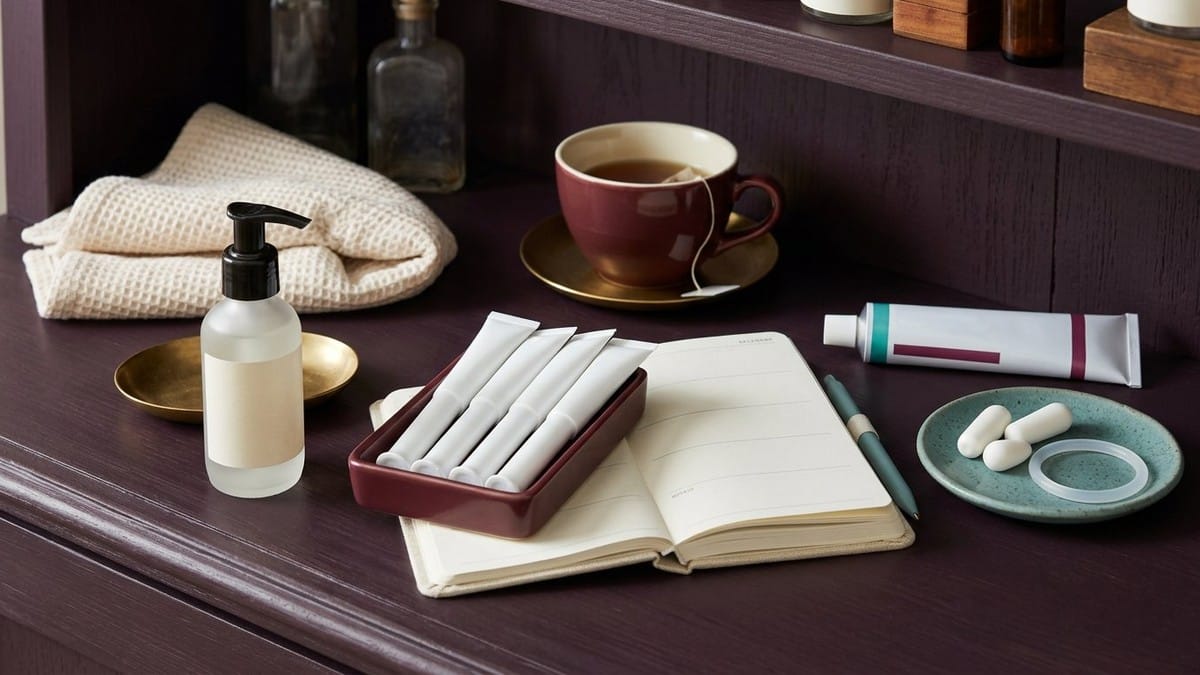
Three products sit in the same pharmacy conversation and are treated as interchangeable: lubricant, vaginal moisturiser and vaginal estrogen. They are not three strengths of the same thing. One reduces friction during sex, one is scheduled background moisture, and one is a local hormone medicine that changes estrogen-deficient tissue.
The three-job table
| Product | Main job | When used | What it does not do | Access |
|---|---|---|---|---|
| Lubricant | Reduce friction and make touch/penetration more comfortable | Immediately before and during sexual activity; reapply as needed | Does not reverse genitourinary syndrome of menopause (GSM) tissue changes | Over the counter |
| Vaginal moisturiser | Bind to vaginal lining and retain water for background dryness | Regularly, commonly 2–3 times a week, independent of sex | Not a hormone and not an instant friction layer for every encounter | Over the counter |
| Low-dose vaginal estrogen | Restore estrogen effects in vaginal tissue: thickness, elasticity, blood flow and lower pH over time | On the prescribed local schedule; benefit builds over weeks | Not a lubricant, and not automatically the right choice for unexplained bleeding or every cancer history | Prescription or pharmacy-regulated depending on place/product |
The North American Menopause Society describes nonhormone lubricants with sex and regularly used long-acting moisturisers as first-line options for GSM. For moderate-to-severe symptoms or symptoms that do not respond, low-dose vaginal estrogen is one of several prescription options. A 2025 AUA/SUFU/AUGS guideline likewise recommends offering local low-dose estrogen and supports moisturisers/lubricants alone or in combination.
Start with the symptom pattern
| Pattern | Product whose job matches | What to notice |
|---|---|---|
| Comfortable day to day, dry only during sex | Lubricant first | Use enough, add more, and check condom/toy compatibility. |
| Dry, itchy or sore even on non-sex days | Moisturiser on schedule, plus lubricant for sex | Judge over weeks, not one application. |
| Splitting, burning, recurrent urinary discomfort, pain despite moisturiser/lubricant | Clinical review for GSM and prescription options | Skin disease, infection and pelvic-floor pain can mimic dryness. |
| Dryness mainly because arousal takes longer or sex starts before the body is ready | Time, stimulation and lubricant | Dryness is not proof of low desire or relationship failure. |
| New bleeding after menopause, lump, sore, discharge or fever | Medical assessment first | Do not label it dryness and keep layering products. |
Lubricant is a tool, not a tissue treatment
Water-based products are easy to clean and compatible with latex condoms and most toy materials, but may need reapplication. Silicone-based products last longer and are condom-compatible, yet can damage some silicone toys and be harder to wash off. Oil can weaken latex and polyisoprene condoms. For exact material combinations, see coconut oil, condoms and toys and toy materials and cleaning.
Very high-osmolality or strongly fragranced products can irritate sensitive tissue. Menopause guidelines increasingly favour products closer to vaginal pH/osmolality. “Warming,” “tingling” and numbing additives are rarely the best first experiment on fragile tissue.
What “low-dose local” means—and does not mean
Modern low-dose vaginal estrogen preparations are designed to act mainly in the vagina, with minimal systemic absorption at standard doses. That is not the same sentence as “no hormone reaches the body” or “history does not matter.” A prescriber still needs to know about unexplained bleeding, estrogen-sensitive cancer, current endocrine treatment, other hormone therapy and product dose/form.
For people with a history of estrogen-dependent breast cancer, ACOG advises nonhormonal treatments first and shared decision-making if local estrogen is considered after inadequate response. The conversation may involve oncology because recurrence risk and current aromatase-inhibitor or tamoxifen treatment change the calculus.
An appointment script that separates the jobs
“I have dryness both during sex and on ordinary days. I am using lubricant only during sex, but the background soreness remains. I would like to separate three options: scheduled moisturiser, lubricant choice, and whether low-dose vaginal estrogen or another GSM treatment fits my history. Could you also check that this is not infection, a skin condition or pelvic-floor pain? If I use local estrogen, what change should I expect by 8–12 weeks, what follow-up is needed, and which symptoms should prompt review sooner?”
Bring the exact products, how often they are used, and whether symptoms are external, at the entrance, deep, urinary or all four. “Dry” is a starting word, not a diagnosis.
What improvement should look like
- Lubricant: less friction during that encounter.
- Moisturiser: gradual reduction in day-to-day dryness with scheduled use.
- Local estrogen: tissue and pH changes over several weeks; sex may still need lubricant.
- No improvement: reconsider diagnosis rather than assuming you simply need more of the same tube.
Bottom line
Use lubricant for friction, moisturiser for background dryness and ask about local estrogen when estrogen-deficient tissue is the problem. They can be layered, but only when each product is being judged on the job it can actually do.
Sources checked 21 October 2026:
- North American Menopause Society 2020 GSM position statement (PDF)
- AUA/SUFU/AUGS Genitourinary Syndrome of Menopause guideline (2025)
- British Society for Sexual Medicine GSM position statement (PDF)
- ACOG: urogenital symptoms after estrogen-dependent breast cancer
This article compares product categories; it does not recommend a brand or dose. Postmenopausal bleeding or a new lesion needs clinical assessment.