The Orgasm Gap in Partnered Sex: Clitoral Anatomy, Time-to-Orgasm Studies and Evidence-Based Alignment
In national probability studies, only 18.4% of women reach orgasm from vaginal penetration alone, and female partnered time-to-orgasm averages ~13.4 minutes vs ~5.4 minutes male IELT. Compare Angling, Rocking, Shallowing and Pairing.

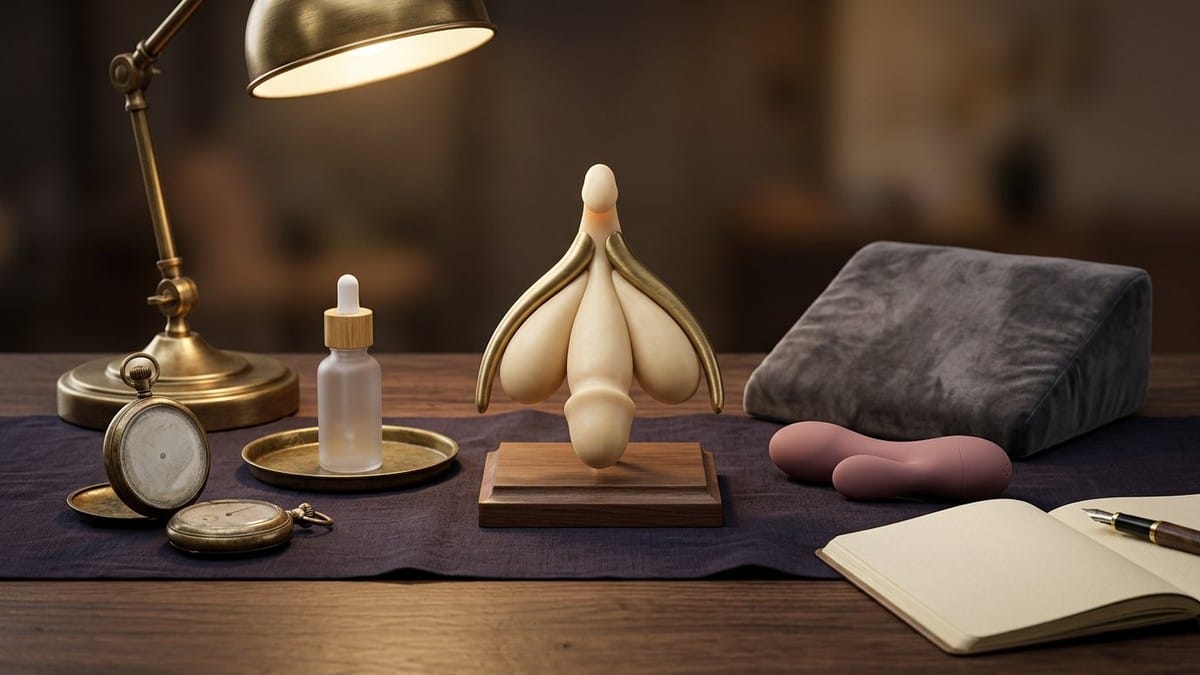
Short answer: If a woman takes 12 to 15+ minutes of continuous clitoral and penetrative stimulation to reach orgasm while a man reaches ejaculation after 4 to 6 minutes of vaginal thrusting, neither partner is broken—you are looking at the documented anatomical and timing structure of human sex. In nationally representative studies (Frederick et al., Archives of Sexual Behavior 2018, n = 52,588; Herbenick et al., J Sex Marital Ther 2018), only 18.4% of women reliably reach orgasm from vaginal penetration alone, whereas over 72% require or strongly benefit from direct clitoral stimulation. Closing the “orgasm gap” is not about trying to thrust for 25 minutes straight; it is about aligning clitoral anatomy, pre-penetration arousal and four named movement techniques (angling, rocking, shallowing and pairing).
Scope & research note: This research explainer examines population-probability datasets, MRI anatomical studies of the clitoral-urethral-vaginal complex, and stopwatch latency studies (Frederick et al. 2018; Hensel et al., PLOS ONE 2021; Sex Roles European Survey 2026). For the male stopwatch distribution, see How Long Does Sex Actually Last? Stopwatch Studies vs Estimates and Finishing in Under Two Minutes: ISSM Criteria.
What the 52,588-person orgasm-gap study actually found
In the largest comparative dataset on partnered orgasm frequency—Frederick et al. (2018, Archives of Sexual Behavior, n = 52,588 US adults), replicated in a 2026 Swiss and European survey in Sex Roles—researchers measured the percentage of adults who reported “usually or always” reaching orgasm during partnered sex:
- Heterosexual men: 95%
- Gay men: 89%
- Bisexual men: 88%
- Lesbian women: 86%
- Bisexual women: 66%
- Heterosexual women: 65%
Two numbers in that list dismantle the myth that female orgasms are inherently “elusive” or biologically slow:
- During solo masturbation, women reach orgasm fast and reliably: Over 90% of women who can orgasm do so consistently during solo stimulation, often within 4 to 8 minutes, because stimulation is applied directly to the external clitoris.
- Lesbian women reach orgasm 86% of the time in partnered sex (21 percentage points higher than heterosexual women): The 30-percentage-point gap between heterosexual men (95%) and heterosexual women (65%) is driven almost entirely by treating in-and-out penile-vaginal intercourse (PVI) as the sole “main event” of sex.
Why intercourse alone triggers orgasm in only 18.4% of women: the anatomy and stopwatch math
Why does unadorned in-and-out vaginal thrusting trigger ejaculation in 95% of men while leaving four out of five women without an orgasm? Two anatomical and stopwatch facts explain the gap:
- The internal and external clitoral complex (O’Connell MRI anatomy): Urologist Helen O’Connell’s MRI and anatomical dissection studies demonstrated that the visible external glans clitoris (which contains thousands of densely packed sensory nerve endings) is only the tip of a larger wishbone-shaped structure. Its internal crura (legs) and erectile vestibular bulbs wrap around the urethra and the outer third (distal 1–2 inches) of the anterior vaginal wall. By contrast, the deeper two-thirds of the vaginal canal have relatively sparse touch receptors, and the distance between the external clitoral glans and the vaginal opening (the clitoral-urinary-vaginal or CUV distance) varies significantly from person to person. When that distance is greater than ~2.5 cm, standard in-and-out thrusting barely moves the external clitoris at all.
- The 5.4-minute vs 13.4-minute stopwatch mismatch: In multi-country stopwatch studies (Waldinger et al. 2005), the median male intravaginal ejaculatory latency time (IELT) is 5.4 minutes. Meanwhile, stopwatch studies of female time-to-orgasm during partnered sex average 13.4 minutes—and in Herbenick et al.’s (2018) US national probability sample of 1,055 women aged 18–94:
- Only 18.4% of women reported that vaginal penetration alone is sufficient for orgasm;
- 36.6% reported that direct clitoral stimulation is strictly necessary to reach orgasm during intercourse;
- An additional 36.0% reported that while not strictly required, concurrent clitoral stimulation makes their orgasms feel substantially better and stronger.
| Partnered sexual combination (Frederick et al. 2018 & Herbenick et al. 2018) | Typical female orgasm rate / pattern | Why this happens anatomically |
|---|---|---|
| Penile-vaginal intercourse (PVI) alone (no manual, oral or vibrator clitoral stimulation) | ~18%–31% consistent orgasm rate | Relies entirely on indirect traction of the internal clitoral bulbs/anterior wall; fails whenever CUV distance is wider or male IELT ends around the 5-minute mark. |
| PVI + concurrent manual clitoral stimulation or oral sex | ~65%–80%+ consistent orgasm rate | Combines direct high-density nerve stimulation of the external glans clitoris with internal pelvic-floor and anterior-wall fullness. |
| PVI + oral sex + manual stimulation + vibrator (“Pairing”) | Highest probability (>80%–86%) | Matches the multi-modal clitoral stimulation duration and consistency seen in female solo and same-sex encounters (PMC10903554). |
Angling, Rocking, Shallowing and Pairing: the 4 named techniques from PLOS ONE
In a landmark nationally representative US probability study of 3,017 women published in PLOS ONE (Hensel et al., 2021), researchers identified and named four specific mechanical adjustments that women use to make vaginal penetration significantly more pleasurable and orgasmic:
| Named technique (Hensel et al., PLOS ONE 2021, n = 3,017) | Percentage of women who use it | Exact mechanical adjustment | Why it works |
|---|---|---|---|
| 1. Angling | 87.5% | Rotating, tilting or raising the pelvis during penetration—for example, placing a firm pillow under the hips or tilting the tailbone upward or downward. | Redirects the angle of the penis or toy directly against the sensitive anterior vaginal wall (internal clitoral urethral sponge) instead of sliding along the posterior wall or hitting the cervix. |
| 2. Shallowing | 84.0% | Keeping penetrative touch—with a penis tip, fingers or toy—just inside the outer 1 to 2 inches of the vaginal entrance before or between deeper thrusts. | Concentrates stimulation where vaginal nerve endings and the internal clitoral vestibular bulbs are densest, while avoiding deep cervical collision. |
| 3. Rocking | 76.4% | Staying fully inside so the base of the penis or pubic bone stays pressed continuously against the external clitoris in a rhythmic grinding/rocking motion, rather than pulling all the way out and thrusting back in. | Provides uninterrupted external clitoral friction and pressure without losing contact on every outward stroke. |
| 4. Pairing | 69.7% | Either the receiver or the partner reaches down with fingers or a small silicone bullet/wand vibrator to stimulate the external clitoris while vaginal penetration is happening simultaneously. | Directly bridges the CUV distance gap so external clitoral stimulation and internal penetration happen together. |
Three practical rules to close the timing and orgasm gap—without pressure
- Put clitoral arousal (or her first orgasm) before penetration: Because median male IELT is ~5.4 minutes while female partnered time-to-orgasm averages ~13.4 minutes, starting with 10+ minutes of oral, manual or vibrator stimulation before penile entry aligns both partners’ clocks without requiring superhuman male stamina.
- Use lubricant early so clitoral touch stays comfortable: Prolonged direct touch on a dry external clitoris causes overstimulation or friction burn. A drop of iso-osmolar water- or silicone-based lubricant makes both Rocking and Pairing effortless.
- Use specific positive cues instead of “faking” or silent guessing: In Frederick et al. (2018) and Wolfer & Carmichael’s 2025 daily-diary study, specific real-time communication—guiding a partner’s hand, asking for a pillow under the hips (Angling), or saying “Keep that exact rhythm and speed right there”—was one of the strongest independent predictors of closing the orgasm gap. See also Mismatched Libido: Spontaneous vs Responsive Desire.
Method, scope and sources
This research explainer synthesises large-scale national probability surveys and peer-reviewed sexual-medicine studies, checked 22 October 2026:
- Frederick DA, St. John HK, Garcia JR, Lloyd EA. Differences in orgasm frequency among gay, lesbian, bisexual, and heterosexual men and women in a US national sample (n = 52,588). Archives of Sexual Behavior. 2018;47(1):273–288 & PMC10903554 (2023) (checked 22 October 2026).
- Hensel DJ, von Hippel CD, Lapage CC, Perkins RH. Women’s techniques for making vaginal penetration more pleasurable: Results from a nationally representative study of adult women in the United States (Angling, Rocking, Shallowing, Pairing). PLOS ONE. 2021;16(4):e0249242 (checked 22 October 2026).
- Herbenick D, Fu TC, Arter J, Sanders SA, Dodge B. Women’s experiences with genital touching, sexual pleasure, and orgasm: results from a US probability sample of women ages 18 to 94. Journal of Sex & Marital Therapy. 2018;44(2):201–212 (checked 22 October 2026).
- Sex Roles (Springer). Exploring the Orgasm Gap in Heterosexual Sex: A Swiss and European Online Survey. 2026 (checked 22 October 2026).
- Wolfer C, Carmichael CL. Personal and perceived partner orgasm pursuit: A daily diary study about the gendered orgasm gap. Journal of Social and Personal Relationships. 2025 (checked 22 October 2026).