When Will Your Period Come After Emergency Contraception—and When to Take a Pregnancy Test?
Emergency contraceptive pills delay ovulation, shifting your next period in roughly 1 in 5 users. Under FSRH and CDC rules, test if your period is >7 days late or at 21 days after unprotected sex.

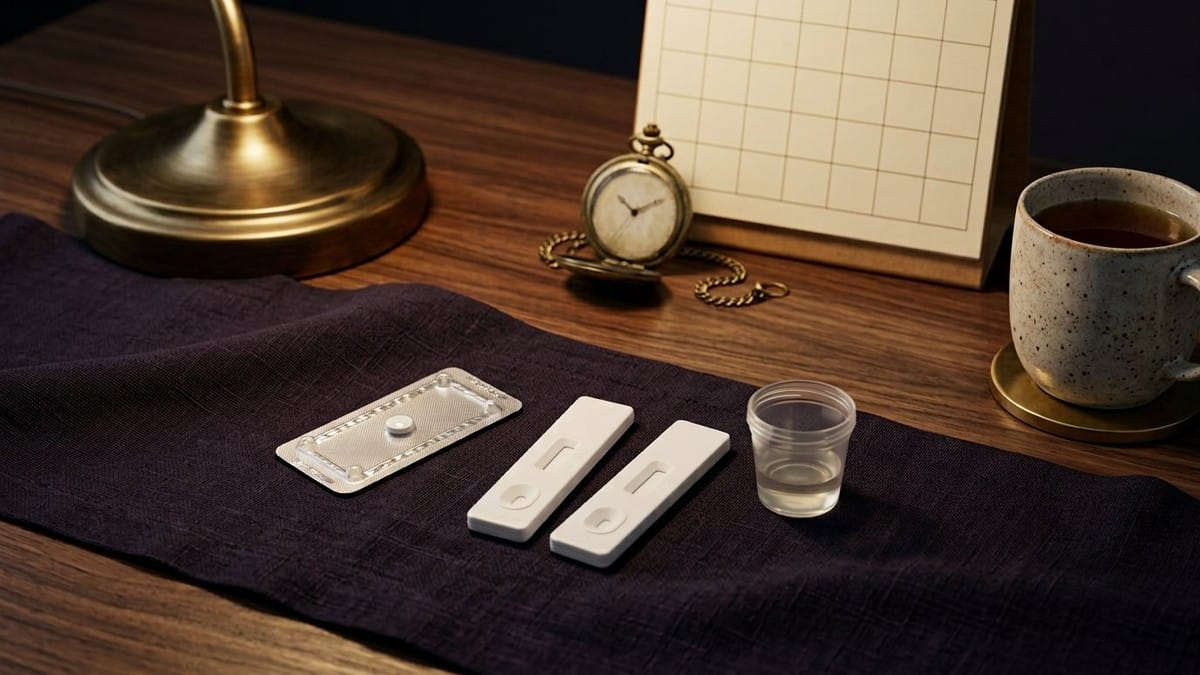
Emergency contraceptive pills work by delaying ovulation—which means they often shift the date of your next period by several days in either direction. Under Faculty of Sexual and Reproductive Healthcare (FSRH) and U.S. CDC emergency contraception guidelines, around three-quarters of people who take levonorgestrel (1.5 mg) or ulipristal acetate (30 mg) get their next menstrual period on time or within 7 days of the expected date, while roughly 1 in 5 experience a delay of more than a week. You should take a high-sensitivity urine pregnancy test if your next period is more than 7 days late, if the bleeding is unusually light, or at 21 days after the last episode of unprotected sex—the point at which a urine test can reliably rule out pregnancy.
Scope and method: This guide compares post-emergency-contraception bleeding patterns, pregnancy-test timing, vomiting rules, and ongoing contraception restart windows across the United States, United Kingdom, Canada and Australia using FSRH, CDC and Mayo Clinic clinical guidance checked on 22 October 2026. It is educational information for adults and does not replace care from a clinician or pharmacist; see our Medical Disclaimer.
Asked online (paraphrased): “I took an emergency contraceptive pill ten days ago, had two days of light brown spotting, and now my actual period is five days late. Was that spotting my period, and if I take a pregnancy test today, can I trust a negative result?”
Why emergency contraception shifts your menstrual cycle
Oral emergency contraceptive pills—both levonorgestrel 1.5 mg (licensed up to 72 hours after unprotected sex, and used off-label up to 96 hours in some guidelines) and ulipristal acetate 30 mg (licensed up to 120 hours / 5 days)—prevent pregnancy primarily by postponing or blocking the luteinizing hormone (LH) surge that triggers ovulation. Because the length of the luteal phase (the time between ovulation and your next period) stays relatively fixed at 12 to 14 days, delaying ovulation by 5 days frequently delays the arrival of your next period by a similar number of days.
A copper intrauterine device (Cu-IUD) inserted within 5 days of unprotected sex works differently: copper ions prevent fertilization and implantation without delaying systemic ovulation, so your next menstrual period usually arrives on schedule (though it is often heavier or crampier than usual, with intermenstrual spotting common in the first month).
Expected bleeding and period timing by emergency contraception method
The table below compares what clinical studies and FSRH emergency contraception guidance report for each method.
| Emergency contraception method | Unprotected-sex window | Spotting before the next period | When the next actual period usually arrives | When to take a urine pregnancy test |
|---|---|---|---|---|
| Levonorgestrel 1.5 mg pill (LNG-EC) | Licensed up to 72 hours (3 days); highest efficacy within 24 hours | Irregular spotting or withdrawal bleed in the first 7 days is common (especially if taken early in the cycle); this is not a true period | Usually on time, or up to 3 to 7 days early or late | If your period is >7 days late, unusually light, or at 21 days after the last unprotected sex |
| Ulipristal acetate 30 mg pill (UPA-EC) | Up to 120 hours (5 days); more effective than LNG-EC across 0–120 hours | Unscheduled spotting occurs in ~15%–20% of users during the cycle | In Phase III trials, ~75% had menses on time or within 7 days; ~20% were >7 days late (and 4% were >20 days late) | If your period is >7 days late, unusually light, or at 21 days after the last unprotected sex |
| Emergency Copper IUD (Cu-IUD) | Up to 120 hours (5 days) after unprotected sex (or up to 5 days after earliest estimated ovulation) | Post-insertion spotting and cramping for several days to weeks is very common | Usually arrives on schedule (around your normal cycle date), often with heavier flow | If no period occurs within 21 days of insertion or if strings cannot be felt |
How to tell pill-related spotting apart from your actual period
One of the most common sources of confusion after taking levonorgestrel or ulipristal is a brief episode of bleeding 3 to 10 days after swallowing the tablet:
- Hormonal withdrawal spotting: As the high single dose of progestogen (levonorgestrel) or selective progesterone receptor modulator (ulipristal) clears your bloodstream, the uterine lining can shed a small amount of pink, brown or light red blood for 1 to 3 days. As FSRH quick-starting guidance warns, light bleeding associated with hormonal pills does not prove that pregnancy was prevented.
- A true menstrual period: Typically matches your usual multi-day flow progression (starting lighter, building to a red flow requiring pads, tampons, a cup or a disc for several days, then tapering off) and arrives close to your expected cycle date (or roughly 5 to 7 days later if ovulation was delayed).
- Implantation or ectopic bleeding: If emergency contraception fails because ovulation had already occurred before you took the pill, early pregnancy or an ectopic pregnancy can cause light, erratic brownish or dark red spotting around the time your period was due. Because spotting alone cannot rule out pregnancy, any unusually light or short “period” after emergency contraception warrants a urine pregnancy test at the 21-day mark.
Why 21 days is the gold-standard clock for a negative pregnancy test
If you take a home urine pregnancy test 6 or 10 days after unprotected sex and it reads negative, that result is too early to trust. Sperm can survive in the upper reproductive tract for up to 5 days, fertilization and travel to the uterus take several more days, and human chorionic gonadotropin (hCG) only begins entering the bloodstream and urine after implantation (typically 6 to 12 days after ovulation).
Because emergency contraception intentionally delays ovulation by up to 5 days, implantation in a cycle where EC fails can happen later than usual. Both UK FSRH guidelines and Canadian and U.S. clinical protocols therefore set the conclusive rule-out date at 21 days (3 weeks) after the last episode of unprotected sex. A positive test at any point is actionable immediately, while a negative test before Day 21 must be repeated at Day 21 if your normal period has not arrived.
Three rules that protect effectiveness after you take the pill
Even when taken within the right hour window, oral emergency contraception can fail if three post-dose rules are missed. For country-specific access rules across the US, UK, Canada and Australia, see Emergency Contraception Across Countries.
| Post-dose situation | Levonorgestrel 1.5 mg (LNG-EC) rule | Ulipristal acetate 30 mg (UPA-EC) rule | Why the clinical rule exists |
|---|---|---|---|
| Vomiting after taking the tablet | If you vomit within 3 hours of taking the dose, take a replacement dose as soon as possible (and ask about anti-nausea medication) | If you vomit within 3 hours of taking the dose, take a replacement dose as soon as possible | Within 3 hours, the tablet may not have been absorbed from the stomach |
| Unprotected sex later in the same cycle | Not protected: Delayed ovulation means you are fertile later in the same cycle; use condoms or abstain until your next period or until ongoing contraception is active | Not protected: Delayed fertile window shifts forward by several days; further unprotected sex in the same cycle carries a high pregnancy risk | Oral EC only delays ovulation for the exposure that already happened—it does not protect future acts |
| Starting or restarting regular hormonal contraception (pill, patch, ring, implant, injection) | Can quick-start immediately (within 24 hours), using condoms for the next 7 days (2 days for traditional progestogen-only pills) + pregnancy test at Day 21 | Wait 5 full days (120 hours) after taking ulipristal before starting any progestogen/hormonal contraception; use condoms during those 5 days PLUS the next 7–14 days + pregnancy test at Day 21 | Starting a progestogen too soon after ulipristal competes at progesterone receptors and impairs ulipristal’s ability to delay ovulation |
| Taking both LNG-EC and UPA-EC together | Do not combine within the same 5-day window | Do not combine within the same 5-day window | Levonorgestrel and ulipristal counteract each other at the progesterone receptor |
Red flags: when to seek urgent medical care
Emergency contraceptive pills do not cause abortion and do not increase the overall rate of ectopic pregnancy—in fact, by preventing pregnancy overall, they lower absolute ectopic risk. However, in the small percentage of cases where pregnancy occurs despite emergency contraception, clinicians always screen for ectopic implantation. According to Mayo Clinic and FSRH guidance, seek urgent medical evaluation if you experience:
- Severe or sharp lower abdominal pain (especially on one side of the pelvis) occurring 2 to 6 weeks after unprotected sex or emergency contraception;
- Dizziness, fainting, lightheadedness or shoulder-tip pain alongside vaginal spotting or bleeding;
- A positive pregnancy test accompanied by pelvic pain or bleeding;
- A period that is more than 7 days late or significantly lighter than normal; or
- Need for STI or HIV post-exposure care: Emergency contraception prevents pregnancy only. If the encounter involved STI or HIV risk, check the Condom Broke or Slipped Timeline, our STI Test Window Periods Guide, and the interactive calculators on Tools & Charts, or visit Talk to a Real Clinician.
Sources and evidence notes
- Faculty of Sexual and Reproductive Healthcare (FSRH) — FSRH Clinical Guideline: Emergency Contraception (checked 22 October 2026).
- U.S. Centers for Disease Control and Prevention (CDC) — U.S. Medical Eligibility Criteria: Classifications for Emergency Contraception (checked 22 October 2026).
- Faculty of Sexual and Reproductive Healthcare (FSRH) — FSRH Clinical Guideline: Quick Starting Contraception (checked 22 October 2026).
- NCBI Bookshelf / CADTH — Ulipristal versus Levonorgestrel for Emergency Contraception: A Review of Comparative Clinical Effectiveness and Guidelines (checked 22 October 2026).
- Mayo Clinic — Ulipristal (Oral Route): Precautions, Menstrual Timing & Side Effects (checked 22 October 2026).
Method & corrections: See How We Research and Corrections.