Sex After a Prostate Biopsy: Waiting Times and the Blood-in-Semen Timeline
Most urology units advise waiting 3 to 7 days before ejaculation after a prostate biopsy. Blood in semen affects almost everyone and commonly lasts 4 to 6 weeks (up to 12 weeks) without harming a partner.

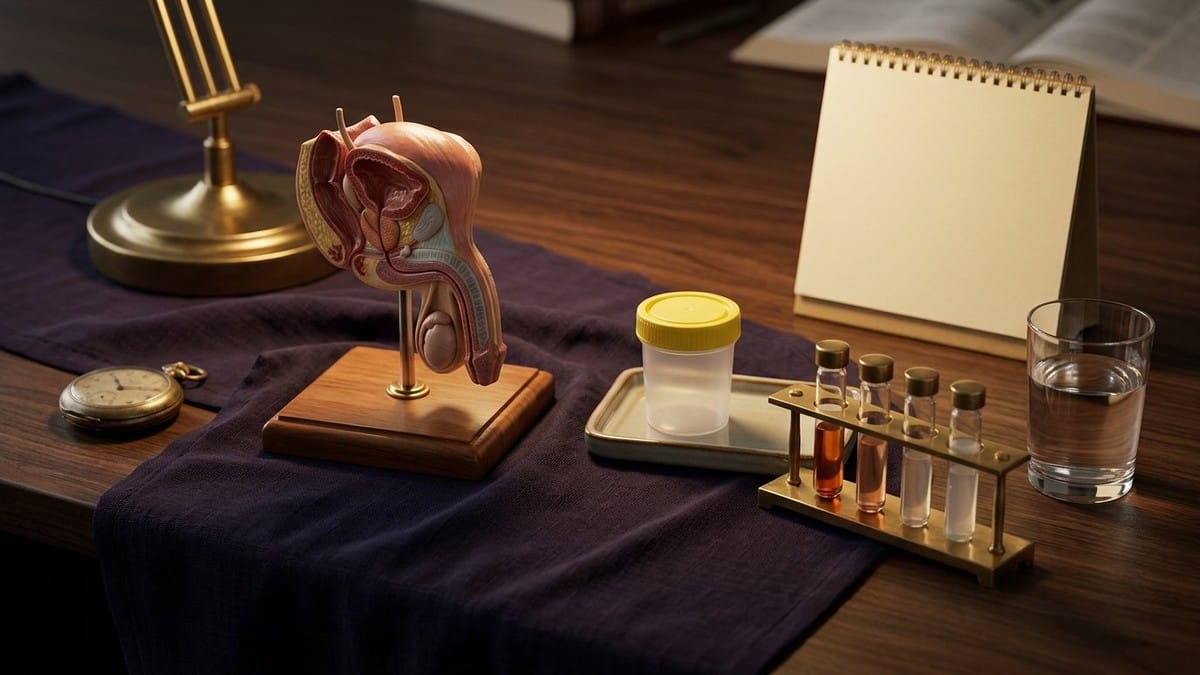
Short answer: Most urology discharge guidelines—including British Association of Urological Surgeons (BAUS) and NHS hospital trust leaflets—advise resting for 24 to 48 hours and waiting 3 to 7 days (until perineal soreness and visible blood in the urine settle) before resuming ejaculation or insertive sex, and 1 to 2 weeks before receptive anal sex, especially after a transrectal biopsy. Once you do ejaculate, blood in the semen (haematospermia) happens in almost everyone and commonly lasts 4 to 6 weeks (and up to 8 to 12 weeks), fading from bright red to dark rust-brown; it is old blood clearing from the prostate and is not harmful to you or a sexual partner.
Few post-procedure symptoms cause as much sudden alarm at night as seeing bright red, wine-coloured or chocolate-brown semen two or three weeks after a prostate biopsy. Because the prostate gland manufactures a large share of seminal fluid and has just had 10 to 18 fine needle cores taken from it, small pockets of blood remain inside the prostatic ducts until repeated ejaculations gradually flush them out.
Transperineal vs transrectal prostate biopsy: what changes for recovery and sex
Modern urology units increasingly perform prostate biopsies via the transperineal route (needles pass through clean skin between the scrotum and anus) rather than the older transrectal route (needles pass through the rectal wall). Both routes bruise the prostate internally, but their surface wounds and infection profiles differ.
| Feature | Transperineal prostate biopsy (TP) | Transrectal ultrasound-guided biopsy (TRUS) |
|---|---|---|
| Where the needle enters | Skin of the perineum (between scrotum and anus) under local or general anaesthetic | Through the front wall of the rectum using an ultrasound probe |
| Surface soreness & bruising | Perineal bruising and sitting tenderness in 10% to 50% of patients for 3 to 7 days | Mild rectal discomfort and light blood on wiping for 2 to 3 days |
| Post-biopsy infection / sepsis risk | Very low (skin can be surgically prepped; often requires no or minimal antibiotics) | Higher risk of rectal bacteria entering the prostate/bloodstream (prophylactic antibiotics essential) |
| Typical wait for masturbation or insertive vaginal/oral sex | Usually 3 to 7 days, once perineal soreness and active urinary bleeding have settled | Usually 3 to 7 days, once rectal bleeding and urinary bleeding have settled (finish prescribed antibiotics) |
| Typical wait for receptive anal penetration or prostate play | Wait at least 1 to 2 weeks until deep prostatic/perineal tenderness resolves | Wait at least 2 weeks until the rectal mucosa puncture sites have fully healed |
The 3 bleeding timelines after a prostate biopsy: urine, rectum and semen
Urologists separate post-biopsy bleeding into three completely different clocks. Confusing the urine clock with the semen clock is why many men think something has ruptured when their semen is still brown in Week 5.
| Fluid / site | What is normal | Normal duration | When to seek urgent medical review |
|---|---|---|---|
| Urine (haematuria) | Rosé-pink or light red urine, occasional small blood specks at the start or end of the stream | Typically 2 to 10 days (up to 14 days; slightly longer if restarting blood thinners) | Frank dark red urine with large clots, worsening bleeding, or inability to pass urine |
| Rectum (after TRUS biopsy) | Streaks of blood on toilet paper or stool | Typically 1 to 3 days | Continuous fresh red rectal bleeding or passing clots from the back passage |
| Semen (haematospermia) | Bright red or pink at first, turning dark red, rust, coffee or chocolate-brown over subsequent ejaculations | Commonly 4 to 6 weeks; NHS urology leaflets note it can persist for 8 to 12 weeks | Accompanied by fever/chills, foul-smelling discharge, or severe worsening pelvic pain |
Does blood in semen harm a partner—and what about temporary erection changes?
Two practical questions come up after almost every prostate biopsy:
- Is bloody or rust-coloured semen dangerous to a partner? No. BAUS and NHS urology patient leaflets explicitly state that post-biopsy blood in semen poses no medical harm to you or your sexual partner. Using a condom during the first few weeks is a purely practical choice if you or your partner prefer to avoid blood-stained sheets or visual surprise.
- Why can erections feel weaker in the first 1 to 3 weeks? BAUS transperineal biopsy data note that mild, temporary erection difficulty occurs in fewer than 1 in 100 men after the procedure (and pelvic soreness or anxiety about seeing blood in semen makes hesitation even more common). Because the neurovascular bundles that drive erections run immediately alongside the prostate capsule, transient bruising and swelling around the gland can briefly dampen firmness before resolving as inflammation subsides.
For a broader guide to non-biopsy causes of pink, red or brown ejaculate, see our evidence guide to watery, clumpy, yellow and pink/brown semen.
When to pause and speak to a clinician immediately
Stop sexual activity and seek urgent medical care (emergency department or your urology team's emergency contact line) if you experience any of the following after a prostate biopsy:
- Signs of post-biopsy infection or sepsis (medical emergency): Fever, shivering/rigors, feeling hot and cold, rapid heart rate, confusion, or severe burning when passing urine. Post-biopsy infection requires urgent hospital assessment and intravenous antibiotics.
- Acute urinary retention: Difficulty passing urine, a trickle stream with a painful full bladder, or complete inability to urinate (caused by temporary prostate swelling or a small blood clot blocking the urethra).
- Heavy urinary or rectal bleeding: Urine that looks like thick tomato soup with clots that do not clear after drinking water, or steady fresh bleeding from the rectum.
Where this could be wrong or incomplete
If you take anticoagulant or antiplatelet medications (such as apixaban, rivaroxaban, warfarin or clopidogrel), or if you had a targeted saturation biopsy taking more than 20 cores, urinary and seminal bleeding often last toward the upper end of the range. Always follow your urologist's exact timeline for restarting blood thinners and resuming strenuous activity.
Related reading on Dot Sexual
- Watery, Clumpy, Yellow or Pink/Brown Semen: Normal Shifts vs When to Test
- Sex and Masturbation After Vasectomy: Wound Healing vs the 12-Week Clearance Test
- Sex and Masturbation After Adult Circumcision or Frenuloplasty: Week-by-Week Healing
- Losing Your Erection When Putting On a Condom: Why It Happens and Practical Fixes
- Interactive Tools & Reference Charts (Post-Procedure Recovery Reference Clock)
Sources and review notes
- British Association of Urological Surgeons (BAUS) — Transperineal Ultrasound-Guided Biopsies of the Prostate: Patient Information Leaflet (checked 22 October 2026).
- British Association of Urological Surgeons (BAUS) — Transrectal Ultrasound-Guided Biopsies of the Prostate (TRUSP): Patient Information Leaflet (checked 22 October 2026).
- University College London Hospitals (UCLH) NHS Foundation Trust — Transperineal Biopsy of the Prostate Aftercare Guidance (checked 22 October 2026).
- The Royal Marsden NHS Foundation Trust — Prostate Biopsy Explained: What to Expect During and After (checked 22 October 2026).
- Bedfordshire Hospitals NHS Foundation Trust — Having a Transperineal Prostate Biopsy Patient Information (checked 22 October 2026).
Asked at 2am. Answered from sources. Last reviewed: 22 October 2026.