Breastfeeding, Prolactin and Postpartum Vaginal Dryness: Why Sex Can Burn Even After Stitches Heal
High prolactin during breastfeeding suppresses ovarian oestrogen to postmenopausal levels, thinning vaginal tissue in 60–80% of lactating mothers. Compare iso-osmolar lubricants, non-hormonal moisturisers and local vaginal oestrogen after 6 weeks.
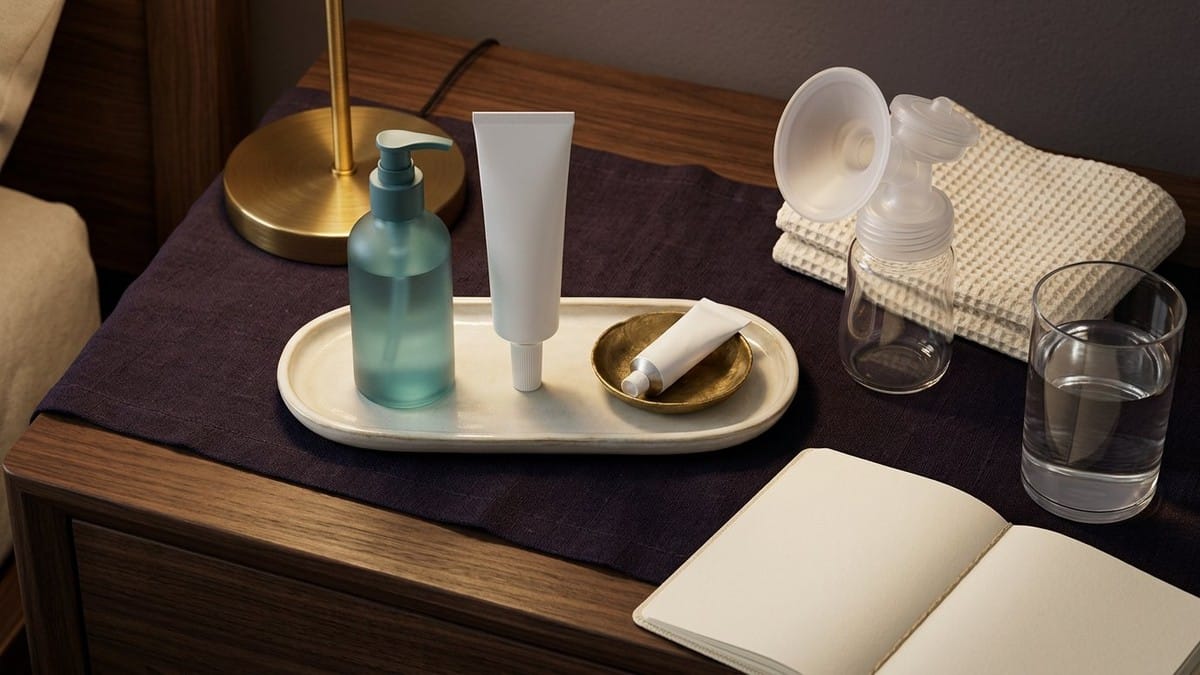
Short answer: If your postpartum stitches or C-section scar have healed at 6 to 8 weeks, yet penetrative sex still feels like sandpaper, raw stinging or burning—even when you pour on lubricant—the cause is usually lactational hypoestrogenism (sometimes called Genitourinary Syndrome of Lactation). While you breastfeed or express milk, high pituitary prolactin suppresses ovarian oestrogen down to postmenopausal levels (`<20–30 pg/mL`), thinning the vaginal lining and raising vaginal pH (GP Infant Feeding Network UK; BMC Women’s Health 2026). Fixing it requires a 3-step ladder: switching to an iso-osmolar, glycerin-free lubricant during sex, using a non-hormonal vaginal moisturiser 2–3 nights a week, and—if pain persists past 6 weeks postpartum—asking your doctor about low-dose local vaginal oestrogen.
Scope & clinical boundary: This guide synthesises endocrine and postpartum gynaecology research (2026 systematic review on sexual function in breastfeeding women; UK Drugs in Lactation Advisory Service / GPIFN; ACOG; NIH LactMed). Always have persistent postpartum pain examined to rule out retained suture granulation tissue or a hypertonic (over-tight) pelvic floor.
Why breastfeeding creates a temporary menopause-like state in vaginal tissue
During pregnancy, placental oestrogen and progesterone reach the highest levels of your life. The moment the placenta is delivered, oestrogen plummets—and if you breastfeed or pump, every feed triggers a surge of prolactin from your pituitary gland.
Prolactin suppresses hypothalamic GnRH, which keeps your ovaries paused in a hypoestrogenic state for months (or until feeding frequency drops and your periods return). As a 2026 systematic review in BMC Women’s Health (2026;26:Article 4358) and clinical series in Medscape document, 60% to 80% of breastfeeding mothers report changes in sexual function, and 17% to 46% have clinically measurable lactational atrophic vulvovaginitis:
- Epithelial thinning and micro-tears: Without oestrogen, the multi-layered vaginal lining thins down to a fragile, pale or erythematous surface that splits or stings under normal friction.
- Why standard pharmacy lube often burns on contact: Because the mucosa is thin and dry, applying a high-osmolality water lube packed with glycerin or propylene glycol (`>1,200 mOsm/kg`) pulls water out of those fragile surface cells, causing immediate stinging (see our osmolality and pH guide).
- Lower natural arousal blood flow and elasticity: Low oestrogen reduces vaginal blood engorgement and glycogen, raising vaginal pH and causing urinary urgency or post-sex stinging even when a urine culture is negative for a UTI.
The 3-tier treatment ladder for breastfeeding vaginal dryness
Just as in perimenopause and menopause, a single tube of lubricant during sex cannot rehydrate tissue that is dry 24 hours a day. Clinicians use a three-tier ladder tailored to lactation safety (GPIFN / UKDILAS; ACOG; NIH LactMed).
| Tier & product category | What it actually does to vaginal tissue | How & when to use it | Breastfeeding & milk-supply safety (checked 22 Oct 2026) |
|---|---|---|---|
| Tier 1: Iso-osmolar water-based or pure silicone lubricant | Reduces friction during sexual contact only. Does not hydrate or thicken tissue between encounters. | Apply generously to the vulvar vestibule and penis/toy during every sexual encounter. Choose unflavoured, fragrance-free, glycol-free water lube (`≤380–1,200 mOsm/kg`, `pH ~3.8–4.5`) or pure silicone lube. | 100% compatible with breastfeeding at any stage postpartum (zero systemic absorption). |
| Tier 2: Non-hormonal vaginal moisturiser (hyaluronic acid or polycarbophil gel/ovules) | Binds water into the mucosal epithelium for 2–3 days and lowers vaginal pH toward normal (`3.8–4.5`), relieving daily dryness and stinging. | Insert internally and apply a pea-sized drop to the vulvar entrance 2 to 3 nights per week at bedtime (not just before sex) for at least 4–8 weeks. | 100% compatible with breastfeeding as soon as lochia/bleeding has stopped and stitches have healed (zero hormones, zero effect on milk supply). |
| Tier 3: Prescription low-dose local vaginal oestrogen (e.g., 10 µg oestradiol vaginal tablet/pessary, ring, or low-dose oestradiol/estriol cream) | Restores the biological root cause: rebuilds epithelial cell thickness, restores glycogen and Lactobacillus acidity, and heals lactational atrophic vaginitis within 2 to 4 weeks. | Typically nightly for 2 weeks, then twice weekly while breastfeeding dryness persists (until weaning or return of menstrual cycles restores natural ovarian oestrogen). | Wait until lactation is established (≥6 weeks postpartum): UK Drugs in Lactation Advisory Service (UKDILAS) and NIH LactMed note that while high-dose systemic oestrogen can reduce milk supply in the first 6 weeks, ultra-low-dose local vaginal oestrogen after 6 weeks has minimal systemic absorption and is widely prescribed with milk-supply monitoring. |
Three other causes of postpartum burning to rule out at your checkup
If you combine a non-hormonal moisturiser and a clean lubricant (or local vaginal oestrogen) and sex still hurts sharply at one spot or deeper inside, ask your GP, midwife, gynaecologist or pelvic floor physiotherapist to check for three common co-existing conditions:
| Symptom pattern during postpartum sex | Likely co-existing contributor | What to ask your clinician or pelvic physio to check |
|---|---|---|
| Sharp, pinpoint stinging or raw bleeding at the 6-o’clock perineal scar | Perineal suture granulation tissue or tethered episiotomy/tear scar tissue. | Ask for a targeted visual examination of the perineal repair line; small areas of over-healing granulation tissue can be treated in minutes in clinic with silver nitrate or topical oestrogen cream, and gentle perineal scar massage (after 6 weeks) softens tight scar bands. |
| Feeling of hitting a “tight muscular wall” just inside the entrance, with deep aching after sex | Secondary pelvic floor hypertonicity (overactive pelvic floor guarding) after birth trauma. | Do not do more squeezing Kegels—see Tight Pelvic Floor vs Weak Pelvic Floor and book a pelvic health physiotherapist for down-training (diaphragmatic release and gentle myofascial release). |
| Fear of pregnancy while breastfeeding without periods | Incomplete Lactational Amenorrhoea Method (LAM) criteria. | Breastfeeding is 98% effective as contraception (LAM) only when all 3 Bellagio criteria hold simultaneously: (1) baby is under 6 months old, (2) you have had zero return of monthly bleeding, AND (3) you are exclusively or near-exclusively breastfeeding day and night without long gaps or routine bottles/dummies. Once any one criterion breaks, use condoms, a copper/hormonal IUD, implant or progestogen-only pill. |
When does breastfeeding vaginal dryness go away on its own?
Unlike permanent post-menopausal atrophy, lactational vaginal dryness is 100% reversible. As your baby starts solid foods around 6 months, stretches out night feeds, or weans—and as your pituitary prolactin peaks decline—your ovaries resume follicular oestradiol production and your menstrual cycle returns. Within 4 to 8 weeks of your periods returning (or completing weaning), natural vaginal thickness, elasticity and lubrication return to their baseline pre-pregnancy state.
Method, scope and sources
This guide synthesises peer-reviewed systematic reviews, lactation pharmacology databases and gynaecology clinical guidance, checked 22 October 2026:
- BMC Women’s Health. Sexual function in breastfeeding women: a systematic review. 2026;26:Article 4358 (checked 22 October 2026).
- GP Infant Feeding Network (GPIFN UK) & UK Drugs in Lactation Advisory Service (UKDILAS). Reproductive Health — Postpartum Vaginal Dryness and Atrophic Vulvovaginitis (checked 22 October 2026).
- National Library of Medicine (NIH). Drugs and Lactation Database (LactMed): Estrogens / Vaginal Estradiol (checked 22 October 2026).
- American College of Obstetricians and Gynecologists (ACOG). Clinical Consensus: Nonhormonal and Local Vaginal Estrogen Treatment of Urogenital Symptoms (checked 22 October 2026).
- Medscape Obstetrics & Gynecology. Lactational Atrophic Vaginitis: Clinical Presentation and Management (checked 22 October 2026).