Tight Pelvic Floor vs Weak Pelvic Floor: Why Random Kegels Can Backfire
Painful penetration, tampon pain, urinary hesitancy and post-ejaculation ache often stem from an overactive (hypertonic) pelvic floor—where squeezing more Kegels worsens tension until you learn to release.

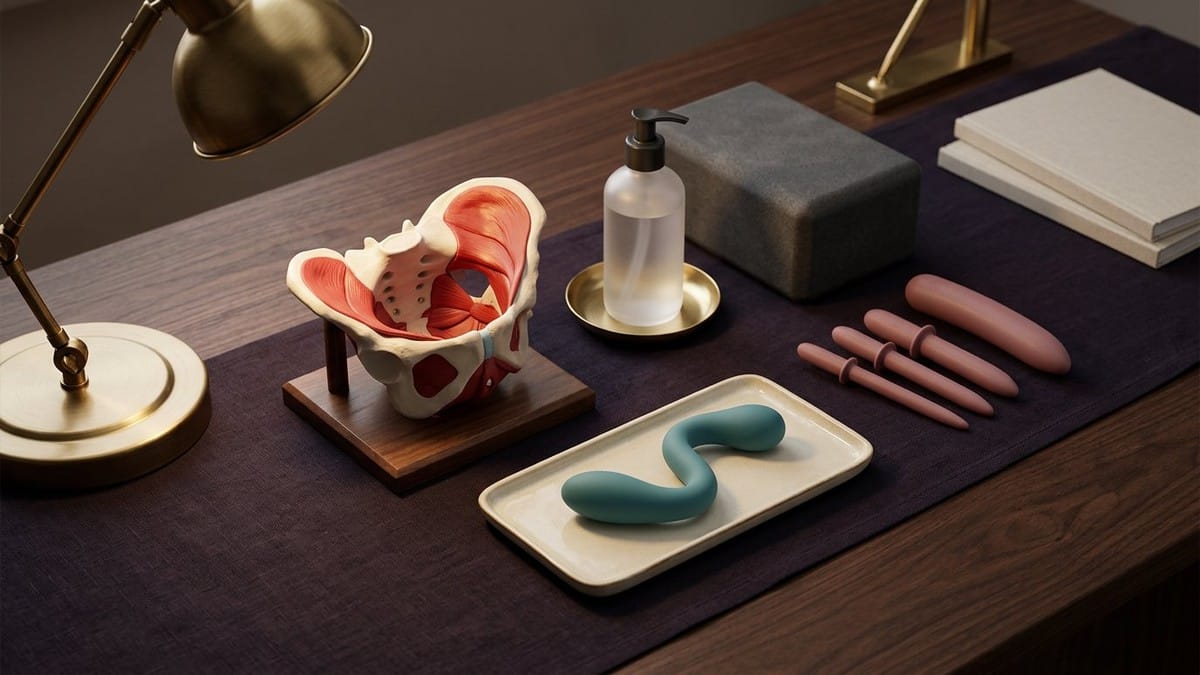
Short answer: Pelvic floor problems are not always caused by weak, stretched muscles—many people with painful penetration, tampon pain, post-ejaculation aching or a slow urinary stream actually have an overactive (hypertonic) pelvic floor, which the International Continence Society (ICS) defines as pelvic floor muscles that do not relax when relaxation is needed. When the pelvic floor is already locked in a high-tone state, doing repetitive Kegel squeeze exercises without learning to release first can increase resting muscle tension and make sexual pain, pelvic aching and bladder urgency worse.
For decades, "do your Kegels" has been handed out as a one-size-fits-all prescription for almost every bladder or sexual concern. Imagine holding your bicep in a tight half-curl all day long until it cramps—and someone tells you the cure is 100 more bicep curls. A muscle held in chronic spasm is both short/tight and functionally weak, because it cannot lengthen through its full range of motion before contracting.
Weak (underactive) vs tight (overactive/hypertonic) pelvic floor: symptom comparison
Pelvic floor physiotherapists evaluate both strength and resting tone / relaxation ability across all bodies (vulvovaginal and penile/prostatic anatomies alike).
| Symptom pattern | Primarily weak / underactive pelvic floor (hypotonic) | Overactive / high-tone pelvic floor (hypertonic) |
|---|---|---|
| What the muscle is doing at rest | Low resting support; struggles to generate or hold a squeeze against sudden downward pressure | Held in elevated resting contraction; fails to drop and lengthen when urination, bowel movement or penetration requires opening |
| Typical bladder symptoms | Stress incontinence: leaking urine when coughing, sneezing, laughing, running or lifting | Hesitancy & urgency: slow start to the urine stream, stop-start flow, feeling like the bladder never quite empties, or frequent bladder urgency without infection |
| Typical sexual symptoms (vaginal/vulvar anatomy) | Reduced grip sensation or vaginal laxity after childbirth; occasional urine leak during penetration | Entry or deep dyspareunia: feeling like penetration hits a "wall", burning/tearing sensation at the opening, pain with tampons or speculum exams, or throbbing ache after sex |
| Typical sexual symptoms (penile/prostatic anatomy) | Post-prostatectomy stress leakage or reduced ejaculatory expulsion force | Testicular, perineal or tip-of-penis ache during or after ejaculation ("chronic pelvic pain syndrome"), hard-flaccid tension, or premature/painful climax |
| Typical bowel & pelvic cues | Pelvic heaviness or dragging sensation at the end of the day; accidental gas/stool leak | Straining to pass even soft stool, pencil-thin stool, tailbone ache, or habit of clenching glutes, abs and jaw under stress |
| What happens if you do 50 fast Kegels a day | Usually improves support and reduces stress leakage over 6 to 12 weeks | Often backfires: increases resting spasm, worsens penetrative pain or post-orgasm ache, and increases urinary hesitancy |
Why a muscle can be "tight and weak" at the same time
One of the most confusing moments for patients is leaking a drop of urine when sneezing and having painful penetration—and being told their pelvic floor is too tight. How can a tight muscle leak?
Skeletal muscle fibres generate force by sliding from a lengthened resting position into a shortened contraction. If your pelvic floor is already held at 70% contraction all day (from bracing against pelvic pain, endometriosis, recurrent UTIs, birth scar tissue, cycling, heavy lifting or chronic stress), it has only 30% of its range left when you cough—and because the muscle is fatigued from constant holding, its reflex timing is slow. Before that muscle can ever build healthy, elastic strength, it has to learn to come down from the ceiling to the floor.
Neuromuscular "down-training": what replaces Kegels when tone is too high
In pelvic floor physical therapy (PFPT) guidelines for hypertonic pelvic floor dysfunction, first-line treatment focuses on down-training and lengthening rather than concentric squeezing:
| Down-training component | What it looks like in practice | Goal before penetrative sex |
|---|---|---|
| 1. Diaphragmatic ("360-degree rib") breathing | As you inhale slowly, the diaphragm moves down and the pelvic floor naturally lengthens/drops slightly; as you exhale, it gently recoils | Re-couples the respiratory diaphragm and pelvic diaphragm so you stop holding your breath and clenching during penetration |
| 2. The pelvic floor "drop" (lengthening without straining) | Consciously letting the sit bones widen and the perineum soften downward (like the moment just before urination starts, without forcefully pushing/bearing down) | Gives you a voluntary release cue at the moment of entry (penis, finger, tampon or speculum) |
| 3. Hip & lumbopelvic release (happy baby pose, deep squat support, child's pose, adductor stretches) | Relaxes the obturator internus, piriformis and inner thigh muscles that share fascia with the pelvic floor | Reduces external myofascial pull on the pelvic bowl |
| 4. Supervised myofascial release & graduated dilators / wands | Guided by a pelvic health physiotherapist to desensitise tender trigger points and retrain the nervous system that touch does not equal threat | Gradually restores comfortable vaginal opening elasticity before partnered thrusting |
How to use the "exhale and drop" cue at the start of penetrative sex
If entry often stings or feels tight for the first minute of sex, notice what your shoulders, jaw, stomach and breath are doing right before penetration. Most people who anticipate pain instinctively inhale, hold their breath, and pull their pelvic floor up into a protective clench—increasing friction right when entry begins. Instead, pause with plenty of water- or silicone-based lubricant, let the penetrating partner stay still at the entrance, take a slow belly-and-rib breath in while consciously softening the pelvic floor downward, and allow entry gradually on the relaxed phase rather than pushing against a clenched ring.
When to pause and speak to a clinician
- New inability to pass urine, numbness in the "saddle" area (groin/buttocks/genitals), or new loss of bowel control alongside back pain: Seek immediate emergency care to rule out spinal nerve compression (cauda equina syndrome).
- Persistent painful penetration, inability to insert a tampon or finger, or chronic perineal/testicular pain lasting more than a few weeks: Ask a GP, gynaecologist or urologist for an evaluation (to rule out infection, dermatoses or endometriosis) and a referral to a specialist pelvic health physiotherapist.
- Postpartum recovery after a perineal tear or episiotomy: See our guide to sex after birth by tear degree and C-section—scar tissue tenderness often triggers protective pelvic floor guarding even when other muscles need rebuilding.
Where this could be wrong or incomplete
You cannot reliably diagnose whether your pelvic floor is hypotonic, hypertonic or mixed from an online checklist alone; a pelvic health physiotherapist or specialist clinician assesses resting tone, excursion, symmetry and relaxation speed during a brief external and/or consented internal exam.
Related reading on Dot Sexual
- Sex After Birth: What Changes After a 1st, 2nd or 3rd/4th-Degree Tear vs a C-Section
- Lubricant vs Vaginal Moisturiser vs Local Estrogen: Which One Solves Dryness and Pain?
- Does Everyone Bleed the First Time? What the Hymen Is—and What Actually Causes First-Time Pain
- Sex With Chronic Back Pain or Arthritis: Flexion vs Extension and Joint-Sparing Setups
- Interactive Tools & Reference Charts
Sources and review notes
- Translational Andrology and Urology — Recognition and Management of Non-Relaxing (Overactive/Hypertonic) Pelvic Floor Dysfunction and ICS Terminology (checked 22 October 2026).
- Current Opinion in Obstetrics and Gynecology (PubMed 31609735) — Evaluation and Treatment of High-Tone Pelvic Floor Dysfunction (checked 22 October 2026).
- Sexual Medicine Society of North America (SMSNA) — Benefits of Pelvic Floor Treatments for Hypertonicity-Related Sexual Dysfunction (checked 22 October 2026).
- Harvard Health Publishing — Pelvic Floor Exercises: Why Tight Pelvic Floor Muscles Need Relaxation Before Strengthening (checked 22 October 2026).
- International Continence Society (ICS) — Standardisation of Terminology of Pelvic Floor Muscle Function and Dysfunction (checked 22 October 2026).
Asked at 2am. Answered from sources. Last reviewed: 22 October 2026.