Menstrual Discs vs Menstrual Cups During Sex: Design, Leaks and IUD Strings
A menstrual disc sits in the vaginal fornix without suction and can stay in during penetrative sex, whereas a standard menstrual cup cannot—and cups carry a documented IUD expulsion risk.
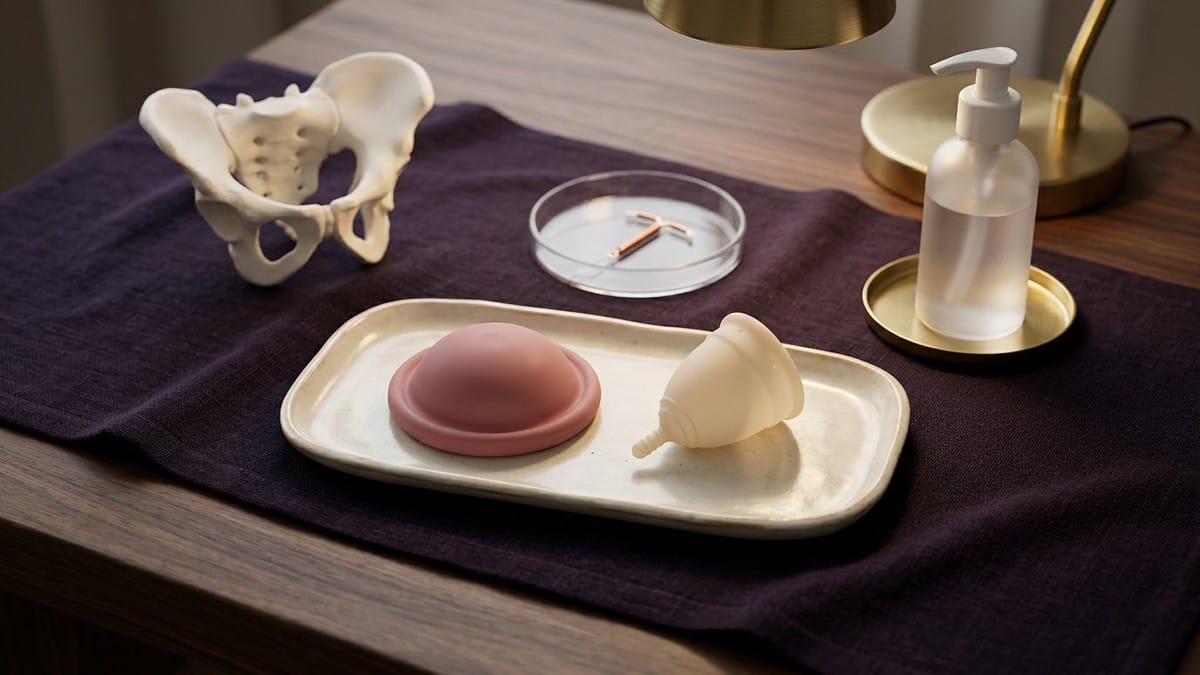
Short answer: A menstrual disc can stay in place during penetrative vaginal sex because it sits high in the vaginal fornix (tucked behind the pubic bone around the cervix) without blocking the lower vaginal canal or using suction, whereas a standard bell-shaped menstrual cup sits lower in the vaginal canal using a suction seal and must be removed before penetrative sex. If you have an intrauterine device (IUD), clinical trial data show higher IUD expulsion and accidental string-pulling rates with menstrual cups (23.2% vs 9.4% cumulative 3-year expulsion in a 2024 copper IUD trial analysis), so breaking the seal and avoiding pinching the strings on removal is essential—and neither a disc nor a cup prevents pregnancy or STIs.
Period sex products are often marketed with vague promises of "mess-free intimacy," leaving two practical questions unanswered: why can a disc stay in when a cup cannot, and what happens if you wear an IUD?
Menstrual disc vs menstrual cup: anatomy, suction and sex compatibility
Although both are reusable or disposable catch barriers rather than absorbent tampons, a menstrual disc and a menstrual cup sit in two different anatomical compartments of the vagina.
| Feature | Menstrual disc (reusable silicone or disposable polymer) | Standard menstrual cup (bell- or bulb-shaped silicone/TPE) |
|---|---|---|
| Where it sits anatomically | High in the vaginal fornix (back rim rests in the posterior fornix behind the cervix; front rim tucks above the pubic bone) | In the lower-to-mid vaginal canal below the cervix, with a stem extending toward the vaginal opening |
| How it stays in place | Anatomical wedging behind the pubic symphysis—does not rely on a suction seal | Outward rim tension plus a light suction seal against the muscular walls of the vaginal canal |
| Can it stay in during penetrative vaginal sex? | Yes: the lower vaginal canal remains open below the collapsed disc pouch | No (for standard cups): the rigid bell and stem occupy the vaginal canal and can cause pain, friction or cervical displacement if pushed inward |
| Can it stay in during external clitoral, oral or anal play? | Yes | Yes (no vaginal penetration involved) |
| Does it prevent pregnancy or STIs? | No: a menstrual disc is not a contraceptive diaphragm and provides zero STI or pregnancy protection | No |
Why menstrual cups carry a documented IUD expulsion risk—and what we know about discs
If you have a copper IUD or hormonal IUS (such as Mirena, Kyleena, Liletta or Jaydess), the way you remove internal period products matters. In a landmark secondary analysis of a 3-year randomised copper IUD trial (Contraception, 2024; 1,046 participants), researchers tracked cumulative IUD expulsions among menstrual cup users versus non-users:
- 12-month copper IUD expulsion rate: 15.8% among menstrual cup users vs 5.0% among non-users.
- 36-month copper IUD expulsion rate: 23.2% among menstrual cup users vs 9.4% among non-users (crude odds ratio 2.90).
- Accidental self-removal via strings: Across both standard TCu380A and mini copper IUDs, menstrual cup users had significantly higher rates of accidentally pulling their own IUD out while pinching the base of the cup to remove it (5.7% vs 0.6% at 36 months in the TCu380A group).
Two mechanisms explain why cups dislodge IUDs: pulling down on a cup without first breaking its vacuum seal creates negative pressure at the cervix, and pinching the bottom of a cup or pulling a disc rim can trap the hanging nylon IUD threads between your fingers and the silicone.
What about menstrual discs with an IUD? Because discs wedge behind the pubic bone without creating a suction seal, they avoid the vacuum mechanism—however, only one participant in the 2024 trial used a disc exclusively, so high-powered comparative trial data on discs and IUD expulsion are still limited, and string trapping during removal remains possible with both.
Practical checklist: using a menstrual disc for period sex (and protecting an IUD)
| Situation | Evidence-based practical step | Why it matters |
|---|---|---|
| Before penetrative sex with a menstrual disc | Empty and rinse the disc (or insert a fresh disposable disc) right before sex, and pee first so the bladder is empty | A full disc can overflow ("auto-dump") when pelvic muscles contract or when deep thrusting compresses the pouch |
| Using condoms alongside a menstrual disc | Check that the front rim of the disc is tucked smoothly behind the pubic bone so it does not rub against an external condom | Silicone/polymer disc rims are chemically compatible with latex and synthetic condoms, but mechanical rubbing against an untucked rim can increase friction |
| Adding lubricant during disc use | Use a water-based lubricant if your reusable disc is made of medical-grade silicone | High-purity silicone lubricants can soften or degrade some silicone menstrual discs over time, just as with silicone sex toys |
| First 6 weeks after new IUD insertion | Use pads or period underwear for at least the first post-insertion bleed; check your clinic's wait window (often 4 to 6 weeks) before starting cups or discs | Baseline IUD expulsion risk is highest during the first menstrual cycles after placement |
| Removing a cup or disc when you have an IUD | Cup: slide a finger up the rim to break the suction seal completely before pulling down. Both: sweep a finger to ensure the IUD strings are not pinched against the silicone | Prevents vacuum pull and accidental string self-extraction |
When to pause and speak to a clinician
- You feel hard plastic at the opening of your cervix, your IUD strings suddenly feel much longer or missing, or you have sudden cramping after removing a cup or disc: Use backup contraception (condoms) immediately and book an IUD thread/ultrasound check—if unprotected sex occurred within the last 5 days, ask about emergency contraception.
- Deep pelvic pain during penetrative sex with a menstrual disc in place: A disc whose diameter is too large for your fornix can press against the cervix or posterior vaginal wall; remove the disc and do not force penetration through pain.
- Disc or cup retained for more than 12 hours, or sudden high fever, vomiting, diarrhoea, dizziness or sunburn-like rash: Remove the device and seek urgent medical care to rule out menstrual toxic shock syndrome (mTSS), which—while rare—has been reported with both tampons and internal menstrual cups.
Where this could be wrong or incomplete
The largest randomized-trial dataset on menstrual cups and IUD expulsion studied two copper IUD models; observational data across levonorgestrel hormonal IUS devices show mixed estimates depending on insertion timing and user removal technique. Furthermore, individual vaginal fornix depth and pubic bone shelf angle vary—so a single one-size menstrual disc does not fit every anatomy without leaking.
Related reading on Dot Sexual
- Sex, Tampons and Baths After IUD Insertion: Infection Window vs Contraceptive Window
- Emergency Contraception Rules by Country: Levonorgestrel, Ulipristal and the 5-Day Copper IUD
- Sex Toy Materials and Cleaning: Silicone, TPE, ABS, Glass and Metal Compared
- Can You Use Coconut Oil as Lube? Condoms, Silicone Toys and Vaginal pH
- Interactive Tools & Reference Charts
Sources and review notes
- Contraception (2024) / PMC11081833 — Menstrual Cup Use and Intrauterine Device Expulsion in a Multicentre Randomised Trial of Copper IUDs (checked 22 October 2026).
- Obstetrics & Gynecology (2020) — Menstrual Cup Use and Intrauterine Device Expulsion in a Copper IUD Trial (checked 22 October 2026).
- UK National Health Service (NHS) — Intrauterine Device (IUD) Aftercare and Thread Check Guidance (checked 22 October 2026).
- U.S. Food and Drug Administration (FDA) — Menstrual Products (Tampons, Pads, Menstrual Cups and Discs): Safety and Toxic Shock Syndrome Precautions (checked 22 October 2026).
- The Lancet Public Health — Menstrual Cup Use, Leakage, Acceptability, and Safety: A Systematic Review and Meta-Analysis (checked 22 October 2026).
Asked at 2am. Answered from sources. Last reviewed: 22 October 2026.