What a Standard STI Panel Actually Tests (and Misses)—Plus Scripts to Ask a New Partner
Routine asymptomatic STI screens across the US, UK, Canada and Australia test chlamydia, gonorrhoea, HIV and syphilis—and omit herpes, HPV and Mycoplasma genitalium unless indicated.

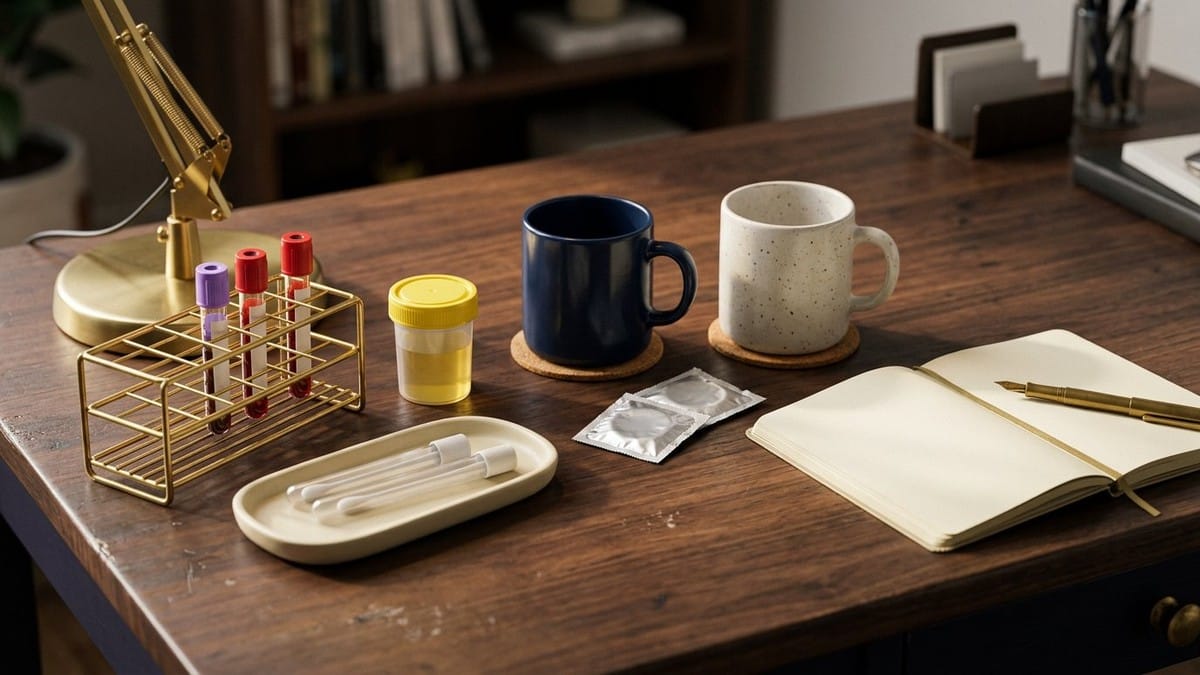
Short answer: When someone says "I got a full STI panel and was tested for everything," they almost never were. Across public sexual health clinics, GP surgeries and postal kits in the United States (CDC), United Kingdom (NHS/BASHH), Canada (PHAC) and Australia (ASHM), a standard asymptomatic "full screen" tests 4 core infections—chlamydia, gonorrhoea, HIV and syphilis (plus hepatitis B and C when indicated). Unless you have specific symptoms or explicitly request extra tests, routine asymptomatic panels do not test for herpes (HSV-1/HSV-2), human papillomavirus (HPV), Mycoplasma genitalium or (in most male panels) trichomoniasis—and a urine-only test misses throat and rectal chlamydia or gonorrhoea.
Knowing what a standard panel includes—and what it leaves out on purpose—does two useful things at once: it stops you from accusing a partner of lying if herpes or HPV shows up later, and it helps you have a calm, specific 60-second testing conversation before moving to barrier-free sex.
What a routine asymptomatic "full STI screen" includes vs omits (US, UK, Canada, Australia)
Public health guidelines deliberately exclude certain infections from routine symptom-free screening because the blood tests have high false-positive rates (herpes IgG) or because treating symptom-free carriers breeds untreatable antibiotic resistance (Mycoplasma genitalium). The 2021/2025 CDC STI Treatment Guidelines explicitly state that clinicians should tell patients which common STIs are not being tested.
| Infection | Included in a standard asymptomatic clinic or postal screen? | Why guidelines include or omit it (CDC / BASHH / PHAC / ASHM) |
|---|---|---|
| Chlamydia (Chlamydia trachomatis NAAT) | YES — Core 4 (first-catch urine or self-taken vaginal swab; throat/rectal swabs if requested/exposed) | Commonly symptom-free; easily cured with antibiotics; untreated infection risks PID and infertility |
| Gonorrhoea (Neisseria gonorrhoeae NAAT) | YES — Core 4 (duplexed on the same NAAT swab/urine tube as chlamydia) | High asymptomatic carriage (especially in the throat and rectum); cured with targeted antibiotic therapy |
| HIV (1 & 2) | YES — Core 4 (lab 4th-generation antigen/antibody vein draw or postal capillary blood) | Universal screening recommended for sexually active adults; window period is 18–45 days (vein lab) or 18–90 days (finger-stick) |
| Syphilis (treponemal / RPR serology) | YES — Core 4 (blood tube or postal microtainer) | Early stages are often unnoticed; completely curable with penicillin; window period up to 90 days |
| Hepatitis B & Hepatitis C | Risk-based / Extended panel (blood test) | Included routinely in prenatal screens, PrEP panels, MSM screens and many comprehensive clinics, but omitted on basic 4-plex postal kits |
| Genital Herpes (HSV-1 & HSV-2) | NO — Omitted unless you have an active sore/blister to swab (or specific partner exposure) | CDC, USPSTF, UK BASHH and Australian guidelines recommend against routine asymptomatic HSV IgG blood screening due to false positives at low index values and inability of blood tests to tell oral from genital HSV-1 |
| Human Papillomavirus (HPV) | NO — Never part of an STI panel (no blood or urine test exists) | Screened only via scheduled cervical screening (age 21/25+) for cancer prevention; there is no routine clinical HPV test for men |
| Mycoplasma genitalium (Mgen) | NO — Symptomatic only (persistent urethritis, cervicitis or PID) | CDC, BASHH and ASHM explicitly advise against asymptomatic Mgen screening because widespread antibiotic use drives macrolide/fluoroquinolone resistance |
| Trichomoniasis (Trichomonas vaginalis NAAT) | Partial — Often omitted in standard asymptomatic panels (especially for men) | Tested when vaginal discharge is present, in women with HIV, or in high-prevalence clinics/expanded private panels |
Why "my doctor tested my urine during my physical" or "my smear test was normal" is not an STI screen
Two hospital misunderstandings trip couples up constantly:
- Routine GP urinalysis vs STI NAAT: A standard urine dipstick or midstream urine culture at a regular check-up looks for bladder infection bacteria (like E. coli), glucose and protein—it does not test for chlamydia or gonorrhoea unless a specific first-catch STI NAAT was ordered.
- Cervical smear (Pap / HPV test) vs STI screen: A routine cervical screening appointment checks solely for high-risk oncogenic HPV and cervical cell changes—it does not test for chlamydia, gonorrhoea, HIV or syphilis unless you asked the nurse to take separate STI swabs at the same time.
Word-for-word scripts to ask a new partner about STI testing (without killing the mood)
Asking "Are you clean?" is vague, stigmatising, and usually gets a reflexive "Yeah, of course" from someone who hasn't had a blood draw in two years. Framing testing as a team logistics step—and offering to swap screenshots or order free mail kits together—works far better:
| Scenario | What to ask or suggest | Word-for-word script (text or in person) |
|---|---|---|
| 1. Before sleeping together for the first time (with condoms) | Share your own most recent test date first so it feels collaborative rather than an interrogation | "I'm really excited about tonight. Quick logistics check—I always use condoms with a new partner, and my last STI screen was in [Month]. When were you last tested?" |
| 2. Moving from condoms to barrier-free sex in a new exclusive relationship | Check the 3 essentials: test date, which infections/sites were tested, and whether the window period has passed since any other partners | "Before we ditch condoms, let's both do a fresh 4-test screen (chlamydia, gonorrhoea, HIV and syphilis) now that we've been exclusive past the window period, and swap our result screenshots." |
| 3. When a partner says "I was tested at my annual check-up, everything was fine" | Gently check whether they saw an actual STI lab report or just routine bloodwork/cholesterol | "Doctors almost never include HIV, syphilis and chlamydia unless you specifically ask—can we check your patient portal app together, or order two free postal kits this week just to be 100% sure?" |
| 4. Disclosing cold sores (HSV-1) or genital herpes before oral/genital contact | State it plainly before skin-to-skin contact and explain how you reduce transmission (avoiding contact during prodrome/outbreaks, barriers, daily valacyclovir if used) | "One thing I always share upfront: I get occasional cold sores [or have HSV-2]. I never do oral/sex if I feel any tingle, and I take daily antiviral suppression—happy to answer any questions so you can decide what feels comfortable." |
To find free public clinics and confidential mail-in kits in the US, UK, Canada and Australia, see our Country Guide to Confidential and Postal STI Testing, and check your exact day count on our STI Test Window-Period Explorer.
When to pause and speak to a clinician
- Any visible sore, blister, ulcer, wart or unusual discharge: Pause sexual contact and visit a sexual health clinic in person—an active sore must be swabbed directly while fresh rather than relying on a standard asymptomatic blood or urine panel.
- Persistent burning urination, pelvic pain or testicular ache after a "negative" chlamydia and gonorrhoea test: Ask the clinic to test specifically for Mycoplasma genitalium (with macrolide-resistance testing) and Trichomonas vaginalis.
- A single low-positive HSV-2 IgG blood result from a private "10-panel" without any history of symptoms: CDC 2021/2025 guidelines warn that single-step HSV-2 EIA index values between 1.1 and 3.0 have a high false-positive rate and require confirmatory two-step testing (such as Biokit or Western blot) before assuming you have genital herpes.
Where this could be wrong or incomplete
Screening panels vary for specific populations: for example, UK BASHH, US CDC and Australian guidelines recommend 3-to-6-monthly 3-site NAAT screening (urine, throat and rectal swabs) plus HIV, syphilis and hepatitis A/B/C checks for gay, bisexual and other men who have sex with men (GBMSM) and people taking HIV PrEP, whereas standard heterosexual postal kits often include only a single genital sample and capillary blood tube unless extra swabs are requested.
Related reading on Dot Sexual
- Confidential and Postal STI Testing by Country: Public Clinics, Self-Sampling and Privacy Rules (US, UK, Canada, Australia)
- STI Test Window Periods: Which Test Can Detect What, and When to Retest
- Non-Latex Condoms: Polyisoprene vs Polyurethane vs Nitrile When Latex Irritates
- Peeing, Washing and Douching After Sex: What Prevents UTIs and What Upsets Vaginal Flora
- Interactive Tools & Reference Charts (STI Test Window-Period Explorer)
Sources and review notes
- U.S. Centers for Disease Control and Prevention (CDC) — Sexually Transmitted Infections Treatment Guidelines: Screening Recommendations and Asymptomatic HSV/M. genitalium Guidance (checked 22 October 2026).
- U.S. CDC Emerging Infectious Diseases — Weighing Potential Benefits and Harms of Mycoplasma genitalium Testing and Why Asymptomatic Screening Is Not Recommended (checked 22 October 2026).
- UK Health Security Agency (UKHSA) — Getting Tested for an STI: What Standard NHS Screens Test For (checked 22 October 2026).
- Public Health Agency of Canada (PHAC) — Sexually Transmitted and Blood-Borne Infections: Guides for Health Professionals (checked 22 October 2026).
- Australian STI Management Guidelines for Use in Primary Care (ASHM) — Standard Asymptomatic STI Screening Recommendations (checked 22 October 2026).
Asked at 2am. Answered from sources. Last reviewed: 22 October 2026.