Vaginismus & GPPPD: Why Penetration Feels Like hitting a Wall and How Dilator Therapy Works
When penetration feels like hitting a solid wall, the pelvic floor muscles are firing an involuntary protective reflex called vaginismus (GPPPD). Here is the clinical Q-tip diagnostic map, why Kegel exercises make spasms worse, and the 6-step dilator and pelvic physiotherapy ladder.

Short answer: If vaginal entry with a finger, tampon, clinic speculum or partner’s penis consistently feels like “hitting a solid brick wall” accompanied by sharp burning or tearing pain—even when you want to have sex and feel emotionally close—clinicians diagnose this as vaginismus, classified under DSM-5-TR and International Society for Sexual Medicine (ISSM) criteria as Genito-Pelvic Pain/Penetration Disorder (GPPPD). Vaginismus is an involuntary conditioned reflex spasm of the outer pelvic floor muscles, not a “narrow anatomy” defect or a lack of love—and across multimodal clinical studies (Journal of Osteopathic Medicine 2025/2026), combining pelvic floor physical therapy, graduated vaginal dilators and cognitive-behavioural sex therapy resolves penetration blocks in 71% to 100% of patients.
Scope & clinical boundary: This clinical guide covers DSM-5-TR and ISSM diagnostic criteria for lifelong and acquired vaginismus (GPPPD), the step-by-step vaginal dilator desensitisation protocol (Merck Manual Professional Edition; Center for Vulvovaginal Disorders), and how to assemble the right care team. For situational wedding-night or early-relationship performance pressure, see Wedding-Night and First-Time Pressure: Why Consummation Is Not a One-Night Deadline.
What happens anatomically during vaginismus: the “brick wall” reflex
When someone without vaginismus anticipates comfortable penetration, the muscles surrounding the vaginal entrance—the bulbocavernosus and the pubococcygeus / levator ani group—lengthen and drop. In vaginismus, the nervous system treats any approaching object at the vaginal vestibule the same way your eyelid treats a finger poking toward your eye: it triggers an instant, involuntary protective slam-shut reflex.
- Why “hitting a wall” is muscular, not bone or a sealed hymen: When the pubococcygeus muscle spasms, it pulls the lower vaginal canal tightly forward against the pubic bone, closing the entrance so firmly that even a cotton bud or fingertip cannot pass. (In rare congenital hymenal variants such as a microperforate or septate hymen, a tissue band is present—which a gentle visual exam by a gynaecologist can distinguish in 60 seconds without forcing a speculum.)
- Why “just relax, have a drink, or push through the pain” makes vaginismus worse: Every time a couple tries to force penetration against a spasmed pelvic floor, the brain logs acute burning pain at the vestibule, strengthening the conditioned fear-spasm loop for the next attempt (FEBRASGO GPPPD Review).
Primary vs secondary vaginismus and DSM-5-TR GPPPD criteria
Under DSM-5-TR and ISSM guidelines, vaginismus and superficial dyspareunia are grouped under Genito-Pelvic Pain/Penetration Disorder (GPPPD) when symptoms persist for at least 6 months and cause distress. Clinicians distinguish two onset patterns plus key co-existing conditions (Cleveland Clinic; StatPearls 2026):
| Clinical pattern | Typical history & presentation | What a specialist checks before starting dilators |
|---|---|---|
| Primary (Lifelong) Vaginismus | Penetration has never been comfortable or possible—often noticed first when trying to insert a tampon as a teenager, during a first smear test, or in an unconsummated relationship where external arousal and clitoral orgasm are completely normal. | Visual external vulvar exam (no forced speculum!) to rule out a congenital hymenal band (septate/cribriform hymen) or provoked vestibulodynia (nerve hypersensitivity at the vestibule). |
| Secondary (Acquired) Vaginismus | Penetrative sex or tampon use was previously pain-free, but the pelvic floor began guarding after a painful trigger—such as perineal birth trauma, breastfeeding or menopausal mucosal thinning, recurrent thrush/UTIs, or endometriosis. | Treat the underlying mucosal or inflammatory trigger first (for example, restoring tissue thickness with local vaginal oestrogen or clearing chronic candidiasis) alongside pelvic floor down-training. |
| Situational vs Global Vaginismus | In global vaginismus, spasm occurs with any object (tampon, finger, speculum, partner); in situational vaginismus, tampons or solo fingers may go in, but spasms occur during partnered intercourse or medical exams. | Addresses both somatic pelvic-floor muscle control and partnered control/anxiety dynamics via couples sensate-focus therapy. |
The 4-step evidence-based treatment ladder
According to the Fourth International Consultation on Sexual Medicine (ICSM / CVVD), the Merck Manual and a 2025/2026 review in the Journal of Osteopathic Medicine, successful treatment follows a progressive four-step ladder where you stay in 100% control of every step:
| Stage | What you do in clinic and at home | Why this sequence breaks the reflex loop |
|---|---|---|
| Step 1: Pause all painful penetration attempts & learn pelvic floor down-training | Take penetrative intercourse completely off the table for several weeks while keeping affectionate non-penetrative intimacy alive. Work with a pelvic floor physical therapist (PFPT) to learn diaphragmatic belly breathing, “reverse Kegels” (pelvic floor drop/lengthening), and gentle external perineal release. Never do squeezing Kegels until taught to lengthen first (see why random Kegels backfire). | Stops re-traumatising the vestibule and teaches your nervous system how to consciously feel—and release—pelvic floor tension before any object touches the entrance. |
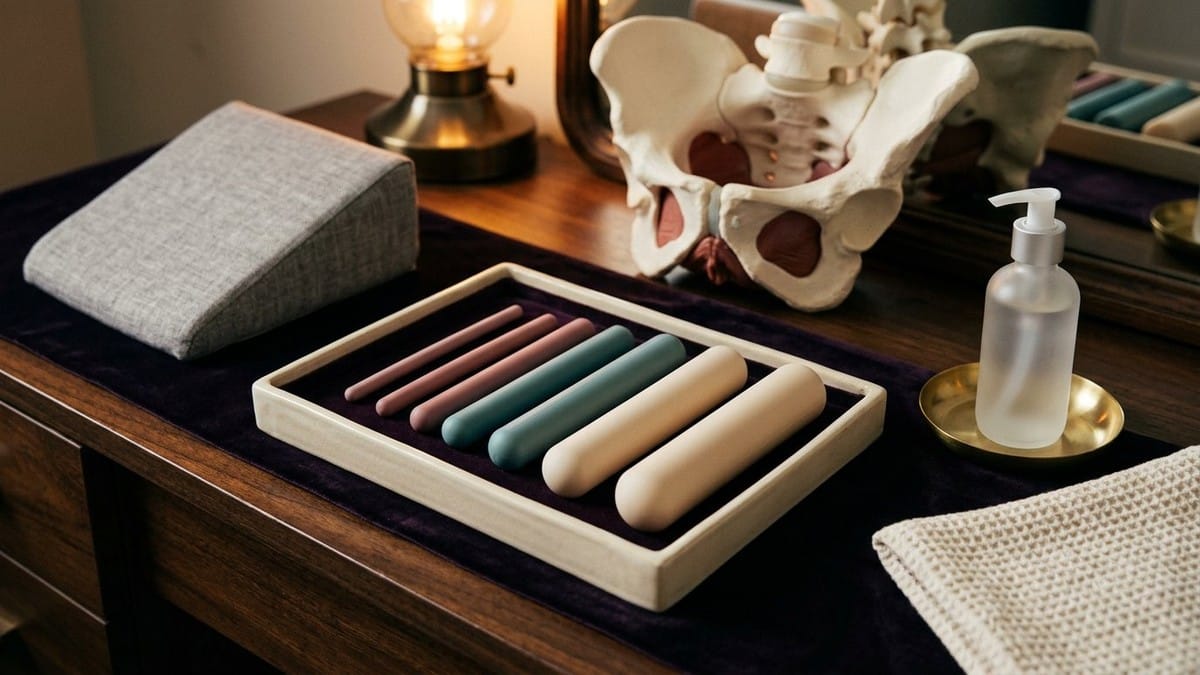
| Step 2: Solo graduated vaginal dilator (trainer) desensitisation | Using a set of 5 to 8 smooth medical-grade silicone dilators (starting as slim as a little finger, `~10–12 mm`) and generous iso-osmolar water-based lubricant, practice solo in a warm, private room 3–5 times a week for 10 to 15 minutes: 1. Inhale into your belly to drop the pelvic floor; 2. Rest the tip at the entrance until anxiety is 0–1/10; 3. Advance slowly on the exhale and leave the dilator resting comfortably inside for 10–15 minutes. Only move up to the next size after the current size feels completely easy and pain-free across several sessions. |
As Merck Manual and CVVD note, dilators do not “stretch a small vagina”—they retrain the spinal reflex so perivaginal muscles experience gentle pressure without automatically contracting. |
| Step 3: Partner-assisted dilator transition &CBT / sensate focus | Once you can comfortably insert a dilator matching your partner’s approximate girth solo, invite your partner into the session: first guiding your partner’s hand as you insert the dilator during sexual arousal, and then practising external penile-vulvar contact without entry. | Transfers the calm, non-spasming reflex from solo practice into partnered sexual arousal so the nervous system does not panic when a partner is present. |
| Step 4: Receiver-guided entry (or specialist adjuncts for refractory cases) | Transition to penetrative sex in a receiver-on-top or side-lying position where the person with vaginismus holds the penis and controls every millimetre of entry, right after warming up with the largest dilator and plenty of lubricant. (In the small minority of severe refractory cases, specialists may add targeted pelvic-floor trigger-point injections or botulinum toxin A under sedation alongside dilator therapy.) | Keeps 100% of depth and speed control in the receiver’s hands, preventing sudden thrusting reflexes. |
Three rules when choosing vaginal dilators and booking a clinician
- Choose medical-grade silicone dilators with small steps between sizes: Avoid giant 4-piece hard-plastic kits that jump abruptly in diameter. Smooth, body-warm platinum-cured silicone dilators with 5 to 8 graduated sizes (paired with a water-based lubricant—never silicone lube on silicone dilators) make size transitions gentle.
- You can refuse a speculum at your first gynaecology appointment: Tell your doctor at the start of the consultation: “I am coming in for suspected vaginismus / painful penetration. Today I would like a visual external examination or a single-cotton-swab check only, and a referral to a pelvic floor physiotherapist—no speculum unless we agree together.”
- Separate fertility timelines from penetration timelines if needed: If you and your partner want to conceive while working through vaginismus treatment, ask your doctor about needle-free home intracervical/intravaginal insemination with a sterile slim oral syringe—many couples conceive comfortably before full-girth intercourse is completed. Find accredited pelvic physio and sex-therapy directories on Talk to a Real Clinician.
Method, scope and sources
This clinical guide synthesises international sexual-medicine consensus statements, gynaecology manuals and peer-reviewed systematic reviews, checked 22 October 2026:
- International Society for Sexual Medicine (ISSM). What is genito-pelvic pain/penetration disorder (GPPPD)? (checked 22 October 2026).
- Merck Manual Professional Edition. Genito-Pelvic Pain/Penetration Disorder (Diagnosis, Pelvic Floor Physical Therapy & Graduated Dilator Protocol) (checked 22 October 2026).
- Journal of Osteopathic Medicine. Emerging treatment options for vaginismus: a comprehensive review of current evidence and future directions. 2025/2026 (checked 22 October 2026).
- Center for Vulvovaginal Disorders (CVVD). Vaginismus / pelvic floor dysfunction (inability to experience vaginal penetration) (checked 22 October 2026).
- Cleveland Clinic & StatPearls (NCBI). Vaginismus: Causes, Symptoms, Diagnosis & Treatment & StatPearls: Dyspareunia and Vaginal Dilator Evaluation. 2026 (checked 22 October 2026).